Option Value - Understanding Premium
When you look at an option chain it can be confusing to know what the option bid/ask prices really mean and how they relate to the strike and stock price.
Before going deep into the mathematics of option pricing, I'm going to help you understand the bigger pieces that make up an option price.
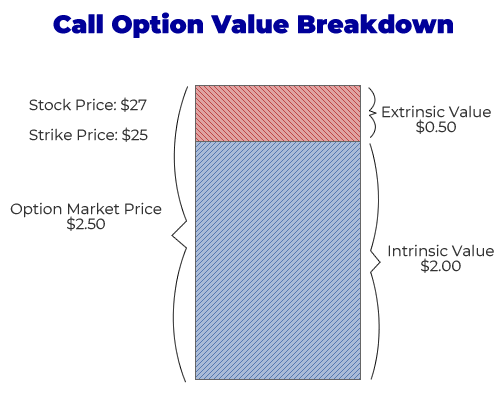
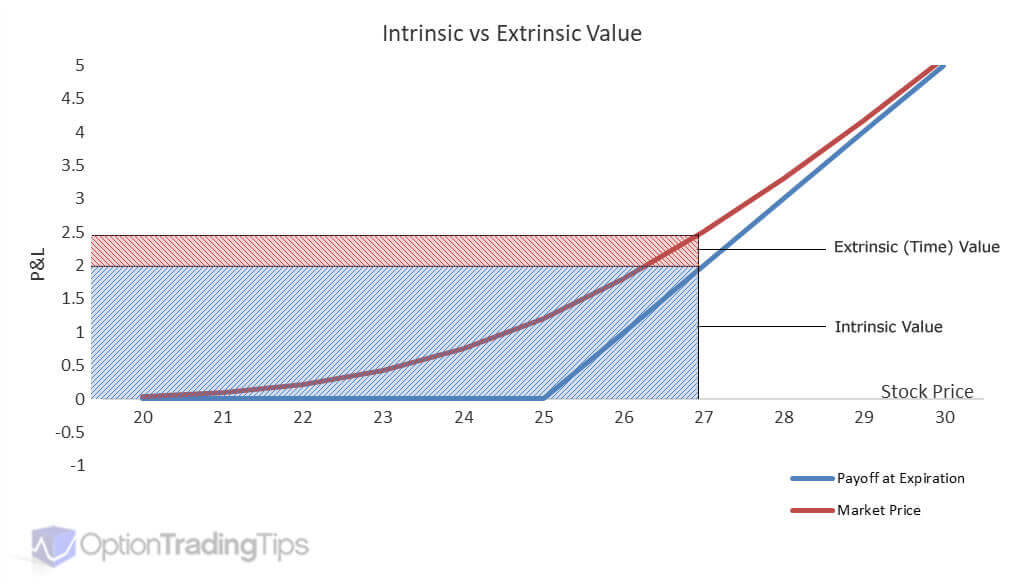
The price of an option can be represented by two components; Intrinsic Value and Extrinsic Value. These values combined make up the option's price. Take a look at these two example diagrams, I will reference these below.
Intrinsic Value
Intrinsic value is the amount of the option price that can be realized if the option is exercised. Only in-the-money options have intrinsic value.
Consider a $25 strike call option on a stock that is trading at $27.
Now, imagine that this particular call option is currently trading at $2.50. How can we better understand the meaning of this price?
Well, the first part we can look at is the option's exercise value; that is, if the option were exercised now, what would be the resulting profit.
If this option were exercised, the buyer of the option would take delivery of the shares with a purchase price of $25. The shares, however, are actually trading at $27, which means an immediate profit of $2.
This $2 is what is referred to as the Intrinsic Value; the value able to be realized if the option is exercised.
With the option priced at $2.50, we have $2 of Intrinsic Value. The remaining $0.50 is called Extrinsic Value.
Extrinsic Value
When the price of an option is trading at more than it's Intrinsic Value, the difference in price is what is called Extrinsic Value, or more commonly known as Time Value.
In our example, we determined that the option is intrinsically worth $2, but given that it is trading at a price of $2.50 means the $0.50 difference is the option's Extrinsic Value.
This $0.50 in time value represents the opportunity that the option still has remaining before it expires. More time means there is more chance that the stock will move in favor of the option buyer.
Options that are in-the-money or at-the-money will have premiums comprised of both intrinsic and extrinsic value. The amount of extrinsic value present in the price will depend on the time remaining until expiration and the implied volatility of the option.
Deep in-the-money options will have close to zero extrinsic value. And an out-of-the-money option price will 100% extrinsic value and 0 intrinsic value.
How to calculate Extrinsic Value?
Calculating the time value present in an option isn't as simple as calculating the intrinsic value; you will need the help of an option pricing model for that. If the option has a European exercise style then a Black and Scholes model will do and if the option has an American Style then you can look at a Binomial Model.
56 Comments
Peter July 29th, 2015 at 7:43pm
Hi Tumelo,
It looks like they are a binary options platform? I'm not familiar with those offerings - I have only traded exchange traded options via a stock broker. I believe these platforms offer a "above or below" type of product?
tumelo mokwena July 28th, 2015 at 2:44am
guys im registered in optiontime but I do not know how to trade please help
Peter December 16th, 2014 at 4:23am
Hi Mike,
Exercising an option means you will need the required capital to take delivery of the stock (if exercising a call, for example). A holder of a long option my simply choose to exit the trade by selling back the option to avoid having to buy the stock and having the trade continue.
Yes, it is just like selling a stock, which means there needs to be a buyer ready to sell to.
Mike December 13th, 2014 at 12:35pm
New to options. My question is why would anyone want to sell an option versus exercising it? I know there is time value + intrinsic value, and you miss out on the time value by exercising it, but I would be afraid that someone would exercise it if I sold it.
Also, if one decides to sell an option can he/she just sell it like selling a stock or does there have to be a buyer who want to buy it?
Peter November 23rd, 2014 at 6:34pm
Hi Souvik,
Mmm, I've not heard of time negatively effecting a put option's value when volatility is high; I always thought time increased the value of both calls and puts.
Where did you read this?
Souvik November 21st, 2014 at 6:15am
Hi,
If time to expiration is more, why would call option only increase in value whereas put options may increase or decrease in value, when volatility is also high?
Thanks, this q is for academic interest only.
Thanks, Souvik - UK
Peter April 28th, 2014 at 6:56am
Hi Ryan,
The price of an option will be comprised of both intrinsic and extrinsic (time) value. As there is still time left in the option before it expires there will be a time value component in the closing price, which will be the closing price minus the intrinsic value.
Ryan April 26th, 2014 at 3:07pm
Can someone tell me why the intrinsic values of the call options are different from the daily closing prices?
Rejoan April 7th, 2014 at 3:07am
Q. why do options always sell at greater than zero? explain with an example
Peter January 2nd, 2014 at 10:57pm
Hi Manojg,
I suppose the best explanation here is that the markets aren't completely efficient; there will always be traders waiting to pounce on arbitrage opportunities because they simply do exist.
Add a Comment