Option Value - Understanding Premium
When you look at an option chain it can be confusing to know what the option bid/ask prices really mean and how they relate to the strike and stock price.
Before going deep into the mathematics of option pricing, I'm going to help you understand the bigger pieces that make up an option price.
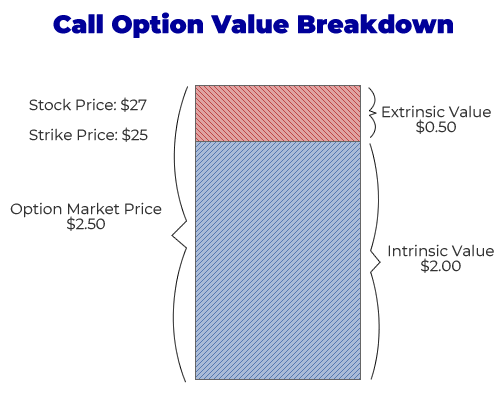
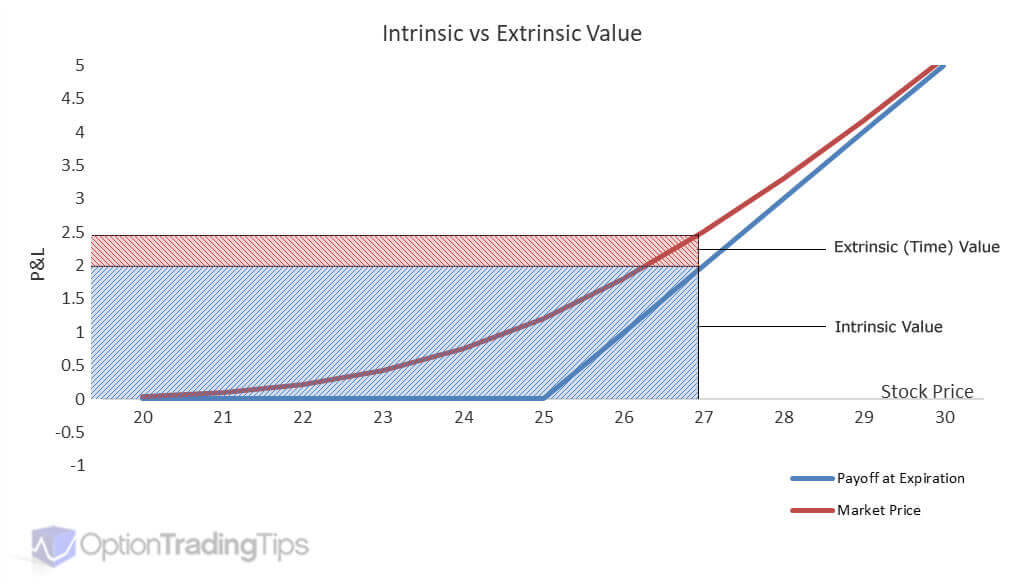
The price of an option can be represented by two components; Intrinsic Value and Extrinsic Value. These values combined make up the option's price. Take a look at these two example diagrams, I will reference these below.
Intrinsic Value
Intrinsic value is the amount of the option price that can be realized if the option is exercised. Only in-the-money options have intrinsic value.
Consider a $25 strike call option on a stock that is trading at $27.
Now, imagine that this particular call option is currently trading at $2.50. How can we better understand the meaning of this price?
Well, the first part we can look at is the option's exercise value; that is, if the option were exercised now, what would be the resulting profit.
If this option were exercised, the buyer of the option would take delivery of the shares with a purchase price of $25. The shares, however, are actually trading at $27, which means an immediate profit of $2.
This $2 is what is referred to as the Intrinsic Value; the value able to be realized if the option is exercised.
With the option priced at $2.50, we have $2 of Intrinsic Value. The remaining $0.50 is called Extrinsic Value.
Extrinsic Value
When the price of an option is trading at more than it's Intrinsic Value, the difference in price is what is called Extrinsic Value, or more commonly known as Time Value.
In our example, we determined that the option is intrinsically worth $2, but given that it is trading at a price of $2.50 means the $0.50 difference is the option's Extrinsic Value.
This $0.50 in time value represents the opportunity that the option still has remaining before it expires. More time means there is more chance that the stock will move in favor of the option buyer.
Options that are in-the-money or at-the-money will have premiums comprised of both intrinsic and extrinsic value. The amount of extrinsic value present in the price will depend on the time remaining until expiration and the implied volatility of the option.
Deep in-the-money options will have close to zero extrinsic value. And an out-of-the-money option price will 100% extrinsic value and 0 intrinsic value.
How to calculate Extrinsic Value?
Calculating the time value present in an option isn't as simple as calculating the intrinsic value; you will need the help of an option pricing model for that. If the option has a European exercise style then a Black and Scholes model will do and if the option has an American Style then you can look at a Binomial Model.
56 Comments
Manojg December 28th, 2013 at 9:48am
If there is not arbitrage in the market (because supply and demand eliminates if there is any arbitrage), then how can a arbitaguers make profit?
Peter August 27th, 2013 at 7:00am
Hi Manoj,
Take a read through the page on Put Call Parity - I think this will help with your question.
Manoj August 27th, 2013 at 1:06am
Can anybody explain me why arbitrage will happen in case the options price is exactly equal to intrinsic value? Please help me as i m lot of confusion with this question.
Peter September 18th, 2012 at 5:39pm
Hi Avijit, yes, that's exactly what extrinsic value is - time value.
Avijit Mete September 18th, 2012 at 5:05am
Thank you very much for the example,however,can we call extrinsic value as a time value of an Option?
Thanks a lot.
Mike May 14th, 2012 at 1:01pm
Trying to understand options and their pricing. Is it correct to say that the option price depends on the probabtility that the option expires ITM? Does the delta (as an absolute number) of an option give the probability that the option will be ITM?
Looking at this big number of different options... how do we value them? with the BS-formula, binomial tree, Monte-Carlo-Simulation,...??? Is there a correct pricing value or are all methods estimations based on their assumptions? F.e. how would you value a barrier option?
Are there some rules of thumb of options values? I am thinking of the value of an American option is always higher than Bermudan than European. I think this order should be correct until expiry and on expiration date the value is the same, namely the intrinsic value, am I right? Do you have an overview which u could upload as it would be interesting to see the different values of exotic options as well.
Thanks in advance!!
Peter April 22nd, 2012 at 7:45pm
Hi Vinny,
Correct - once you have sold back (or sold to close) the option you no longer have a position in the call option and hence no obligation to deliver anything.
It's only if you have a short position (sell to open) in a call option that you have the obligation to deliver.
Vinny April 22nd, 2012 at 2:46pm
Hey Peter,
Great Site! I know you have gotten many similar questions to this, but I just have to ask to be completely sure.
I buy a call and I see the value of the call went up in price then I can sell it back on the market for a quick profit... however, I am still not responsible for providing the stock if the option is exercised, correct? The original writer of the call is still on the hook...
Peter April 15th, 2012 at 10:20pm
Hi DH,
For a long call option the P&L is the max(stock - strike, 0) - premium paid. Let's assume the price of the 2.50 strike option is 0.10 - so you paid $10 for the option.
If the stock is at 2.70 by the expiration date then the profit to you is $10 (2.70 - 2.50 - 0.10) * 100.
DH April 13th, 2012 at 2:05pm
I have a July call option opened on a stock with a strike price of $2.50. The underlying stock is currently trading at $1.70'ish. I am trying to learn how to calculate potential profit with options once the pps exceeds the strike price. If by July the stock moves above $2.50, say $2.51 or $2.60 even, how much will the option be worth if I sell it? And is that multiplied by 100 (per contract)? Thx.
Add a Comment