Option Value - Understanding Premium
When you look at an option chain it can be confusing to know what the option bid/ask prices really mean and how they relate to the strike and stock price.
Before going deep into the mathematics of option pricing, I'm going to help you understand the bigger pieces that make up an option price.
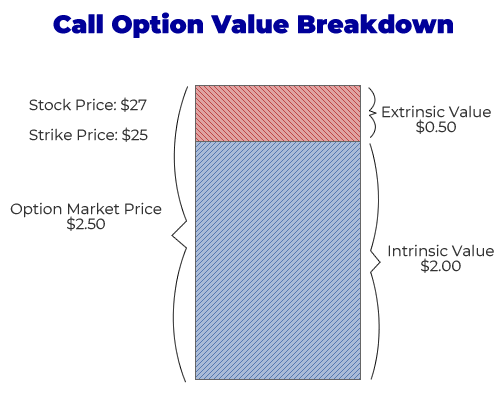
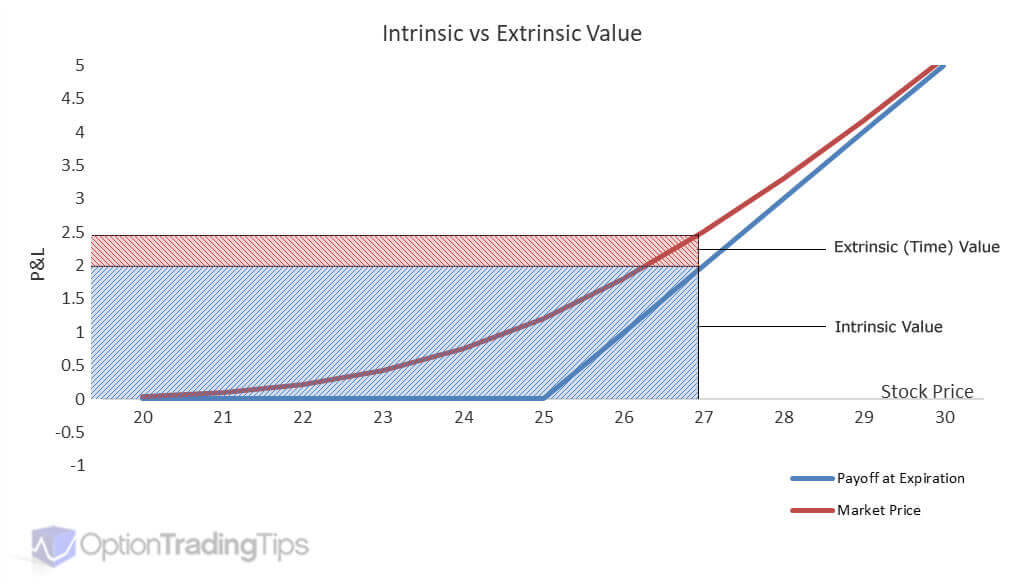
The price of an option can be represented by two components; Intrinsic Value and Extrinsic Value. These values combined make up the option's price. Take a look at these two example diagrams, I will reference these below.
Intrinsic Value
Intrinsic value is the amount of the option price that can be realized if the option is exercised. Only in-the-money options have intrinsic value.
Consider a $25 strike call option on a stock that is trading at $27.
Now, imagine that this particular call option is currently trading at $2.50. How can we better understand the meaning of this price?
Well, the first part we can look at is the option's exercise value; that is, if the option were exercised now, what would be the resulting profit.
If this option were exercised, the buyer of the option would take delivery of the shares with a purchase price of $25. The shares, however, are actually trading at $27, which means an immediate profit of $2.
This $2 is what is referred to as the Intrinsic Value; the value able to be realized if the option is exercised.
With the option priced at $2.50, we have $2 of Intrinsic Value. The remaining $0.50 is called Extrinsic Value.
Extrinsic Value
When the price of an option is trading at more than it's Intrinsic Value, the difference in price is what is called Extrinsic Value, or more commonly known as Time Value.
In our example, we determined that the option is intrinsically worth $2, but given that it is trading at a price of $2.50 means the $0.50 difference is the option's Extrinsic Value.
This $0.50 in time value represents the opportunity that the option still has remaining before it expires. More time means there is more chance that the stock will move in favor of the option buyer.
Options that are in-the-money or at-the-money will have premiums comprised of both intrinsic and extrinsic value. The amount of extrinsic value present in the price will depend on the time remaining until expiration and the implied volatility of the option.
Deep in-the-money options will have close to zero extrinsic value. And an out-of-the-money option price will 100% extrinsic value and 0 intrinsic value.
How to calculate Extrinsic Value?
Calculating the time value present in an option isn't as simple as calculating the intrinsic value; you will need the help of an option pricing model for that. If the option has a European exercise style then a Black and Scholes model will do and if the option has an American Style then you can look at a Binomial Model.
56 Comments
vinit patil February 17th, 2012 at 12:52pm
hi peter,
can you tell me what are, Interst rate,Dividend yeild,volatility & Rounding.
where can one get info. about above terms.
i'am asking this b'coz,they are required in Option price calculator.
thank you
-vinit
Parth Dave December 24th, 2011 at 11:54am
Thanks much for providing so smooth explanation.Everything seems like crystal clear now.
Peter December 11th, 2011 at 5:03pm
Hi Al,
If there is a dividend payment due then it is possible that you may have your option exercised.
Holding a call option alone doesn't carry any rights to dividend payments so a holder of a call option may exercise the option in order to have the shares delivered to ensure that they collect the dividend payment.
Al Moura December 10th, 2011 at 2:10pm
I sold a 12 call while the underlying was trading at $18.77.Is there the possiblity of that call holder to exercise it? I believe that if the call holder exercise it he will receive only $12 for a stock trading at $18.00. Correct? So there is no chance to be exercised under those conditions.
Correct?
Peter October 3rd, 2011 at 11:03pm
Delta is only relevant for the extrinsic part of the option value. Options that are comprised of only intrinsic value will show deltas of +1 for calls and -1 for puts.
B. Thansdowne September 30th, 2011 at 10:33am
Hi Peter
Very helpful explanation. Could you please explain where "delta" fits into all this?
Many thanks
Peter July 31st, 2011 at 7:02pm
Correct - so for a put option, say $25 put option is trading at 0.50. Then intrinsic value = 0 and extrinsic value = 0.50. MSFT will need to trade at or below $24.50 for you to be profitable.
jeff r July 30th, 2011 at 3:13pm
I'm new and need to understand....msft $25 sept 30 call @ 7 trading at $30 presently...My intrinsic value = 5 and extrinsic value = 2...I would be profitable if msft would trade > 32 right? and if you could use an example of a put option using simple example....thx....jeff
Peter July 24th, 2011 at 5:29pm
For call options intrinsic value is zero when the strike price is above the underlying price and for put options intrinsic value is zero when the strike price is below the strike price.
nagesh HOTKAR July 24th, 2011 at 4:03pm
hi,
plz explain when does the intrisic value becomes zero.
Add a Comment