Option Value - Understanding Premium
When you look at an option chain it can be confusing to know what the option bid/ask prices really mean and how they relate to the strike and stock price.
Before going deep into the mathematics of option pricing, I'm going to help you understand the bigger pieces that make up an option price.
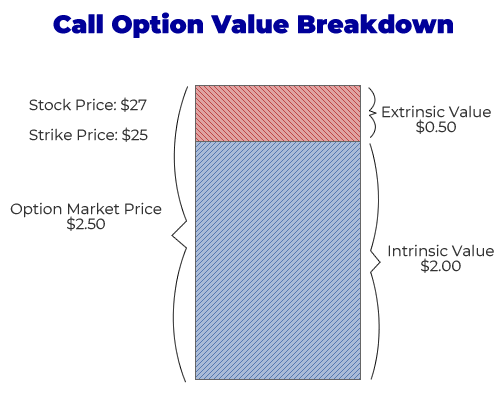
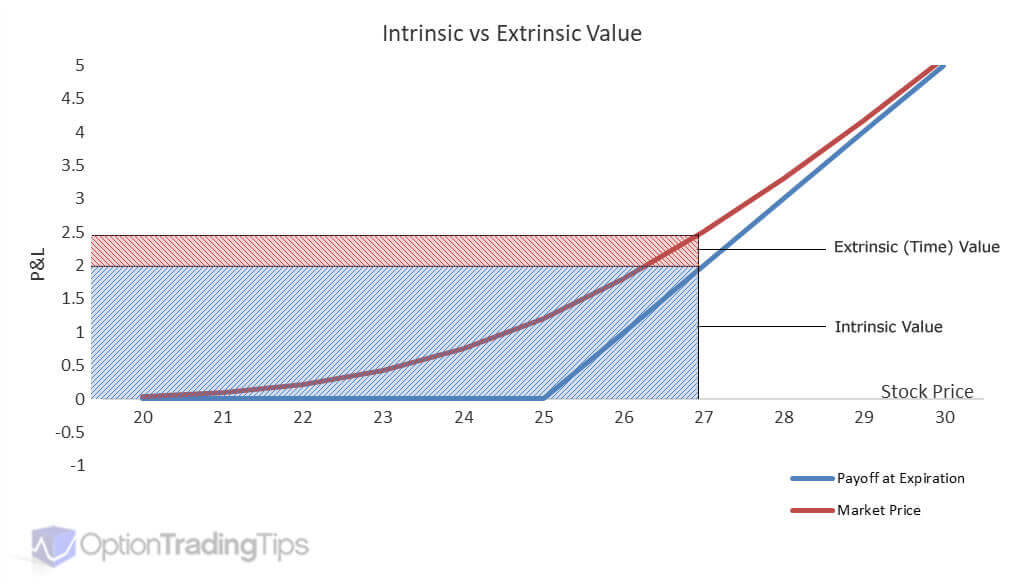
The price of an option can be represented by two components; Intrinsic Value and Extrinsic Value. These values combined make up the option's price. Take a look at these two example diagrams, I will reference these below.
Intrinsic Value
Intrinsic value is the amount of the option price that can be realized if the option is exercised. Only in-the-money options have intrinsic value.
Consider a $25 strike call option on a stock that is trading at $27.
Now, imagine that this particular call option is currently trading at $2.50. How can we better understand the meaning of this price?
Well, the first part we can look at is the option's exercise value; that is, if the option were exercised now, what would be the resulting profit.
If this option were exercised, the buyer of the option would take delivery of the shares with a purchase price of $25. The shares, however, are actually trading at $27, which means an immediate profit of $2.
This $2 is what is referred to as the Intrinsic Value; the value able to be realized if the option is exercised.
With the option priced at $2.50, we have $2 of Intrinsic Value. The remaining $0.50 is called Extrinsic Value.
Extrinsic Value
When the price of an option is trading at more than it's Intrinsic Value, the difference in price is what is called Extrinsic Value, or more commonly known as Time Value.
In our example, we determined that the option is intrinsically worth $2, but given that it is trading at a price of $2.50 means the $0.50 difference is the option's Extrinsic Value.
This $0.50 in time value represents the opportunity that the option still has remaining before it expires. More time means there is more chance that the stock will move in favor of the option buyer.
Options that are in-the-money or at-the-money will have premiums comprised of both intrinsic and extrinsic value. The amount of extrinsic value present in the price will depend on the time remaining until expiration and the implied volatility of the option.
Deep in-the-money options will have close to zero extrinsic value. And an out-of-the-money option price will 100% extrinsic value and 0 intrinsic value.
How to calculate Extrinsic Value?
Calculating the time value present in an option isn't as simple as calculating the intrinsic value; you will need the help of an option pricing model for that. If the option has a European exercise style then a Black and Scholes model will do and if the option has an American Style then you can look at a Binomial Model.
PeterJuly 29th, 2015 at 7:43pm
Hi Tumelo,
It looks like they are a binary options platform? I'm not familiar with those offerings - I have only traded exchange traded options via a stock broker. I believe these platforms offer a "above or below" type of product?
tumelo mokwenaJuly 28th, 2015 at 2:44am
guys im registered in optiontime but I do not know how to trade please help
PeterDecember 16th, 2014 at 4:23am
Hi Mike,
Exercising an option means you will need the required capital to take delivery of the stock (if exercising a call, for example). A holder of a long option my simply choose to exit the trade by selling back the option to avoid having to buy the stock and having the trade continue.
Yes, it is just like selling a stock, which means there needs to be a buyer ready to sell to.
MikeDecember 13th, 2014 at 12:35pm
New to options. My question is why would anyone want to sell an option versus exercising it? I know there is time value + intrinsic value, and you miss out on the time value by exercising it, but I would be afraid that someone would exercise it if I sold it.
Also, if one decides to sell an option can he/she just sell it like selling a stock or does there have to be a buyer who want to buy it?
PeterNovember 23rd, 2014 at 6:34pm
Hi Souvik,
Mmm, I've not heard of time negatively effecting a put option's value when volatility is high; I always thought time increased the value of both calls and puts.
Where did you read this?
SouvikNovember 21st, 2014 at 6:15am
Hi,
If time to expiration is more, why would call option only increase in value whereas put options may increase or decrease in value, when volatility is also high?
Thanks, this q is for academic interest only.
Thanks, Souvik - UK
PeterApril 28th, 2014 at 6:56am
Hi Ryan,
The price of an option will be comprised of both intrinsic and extrinsic (time) value. As there is still time left in the option before it expires there will be a time value component in the closing price, which will be the closing price minus the intrinsic value.
RyanApril 26th, 2014 at 3:07pm
Can someone tell me why the intrinsic values of the call options are different from the daily closing prices?
RejoanApril 7th, 2014 at 3:07am
Q. why do options always sell at greater than zero? explain with an example
PeterJanuary 2nd, 2014 at 10:57pm
Hi Manojg,
I suppose the best explanation here is that the markets aren't completely efficient; there will always be traders waiting to pounce on arbitrage opportunities because they simply do exist.
ManojgDecember 28th, 2013 at 9:48am
If there is not arbitrage in the market (because supply and demand eliminates if there is any arbitrage), then how can a arbitaguers make profit?
PeterAugust 27th, 2013 at 7:00am
Hi Manoj,
Take a read through the page on Put Call Parity - I think this will help with your question.
ManojAugust 27th, 2013 at 1:06am
Can anybody explain me why arbitrage will happen in case the options price is exactly equal to intrinsic value? Please help me as i m lot of confusion with this question.
PeterSeptember 18th, 2012 at 5:39pm
Hi Avijit, yes, that's exactly what extrinsic value is - time value.
Avijit MeteSeptember 18th, 2012 at 5:05am
Thank you very much for the example,however,can we call extrinsic value as a time value of an Option?
Thanks a lot.
MikeMay 14th, 2012 at 1:01pm
Trying to understand options and their pricing. Is it correct to say that the option price depends on the probabtility that the option expires ITM? Does the delta (as an absolute number) of an option give the probability that the option will be ITM?
Looking at this big number of different options... how do we value them? with the BS-formula, binomial tree, Monte-Carlo-Simulation,...??? Is there a correct pricing value or are all methods estimations based on their assumptions? F.e. how would you value a barrier option?
Are there some rules of thumb of options values? I am thinking of the value of an American option is always higher than Bermudan than European. I think this order should be correct until expiry and on expiration date the value is the same, namely the intrinsic value, am I right? Do you have an overview which u could upload as it would be interesting to see the different values of exotic options as well.
Thanks in advance!!
PeterApril 22nd, 2012 at 7:45pm
Hi Vinny,
Correct - once you have sold back (or sold to close) the option you no longer have a position in the call option and hence no obligation to deliver anything.
It's only if you have a short position (sell to open) in a call option that you have the obligation to deliver.
VinnyApril 22nd, 2012 at 2:46pm
Hey Peter,
Great Site! I know you have gotten many similar questions to this, but I just have to ask to be completely sure.
I buy a call and I see the value of the call went up in price then I can sell it back on the market for a quick profit... however, I am still not responsible for providing the stock if the option is exercised, correct? The original writer of the call is still on the hook...
PeterApril 15th, 2012 at 10:20pm
Hi DH,
For a long call option the P&L is the max(stock - strike, 0) - premium paid. Let's assume the price of the 2.50 strike option is 0.10 - so you paid $10 for the option.
If the stock is at 2.70 by the expiration date then the profit to you is $10 (2.70 - 2.50 - 0.10) * 100.
DHApril 13th, 2012 at 2:05pm
I have a July call option opened on a stock with a strike price of $2.50. The underlying stock is currently trading at $1.70'ish. I am trying to learn how to calculate potential profit with options once the pps exceeds the strike price. If by July the stock moves above $2.50, say $2.51 or $2.60 even, how much will the option be worth if I sell it? And is that multiplied by 100 (per contract)? Thx.
vinit patilFebruary 17th, 2012 at 12:52pm
hi peter,
can you tell me what are, Interst rate,Dividend yeild,volatility & Rounding.
where can one get info. about above terms.
i'am asking this b'coz,they are required in Option price calculator.
thank you
-vinit
Parth DaveDecember 24th, 2011 at 11:54am
Thanks much for providing so smooth explanation.Everything seems like crystal clear now.
PeterDecember 11th, 2011 at 5:03pm
Hi Al,
If there is a dividend payment due then it is possible that you may have your option exercised.
Holding a call option alone doesn't carry any rights to dividend payments so a holder of a call option may exercise the option in order to have the shares delivered to ensure that they collect the dividend payment.
Al MouraDecember 10th, 2011 at 2:10pm
I sold a 12 call while the underlying was trading at $18.77.Is there the possiblity of that call holder to exercise it? I believe that if the call holder exercise it he will receive only $12 for a stock trading at $18.00. Correct? So there is no chance to be exercised under those conditions.
Correct?
PeterOctober 3rd, 2011 at 11:03pm
Delta is only relevant for the extrinsic part of the option value. Options that are comprised of only intrinsic value will show deltas of +1 for calls and -1 for puts.
B. ThansdowneSeptember 30th, 2011 at 10:33am
Hi Peter
Very helpful explanation. Could you please explain where "delta" fits into all this?
Many thanks
PeterJuly 31st, 2011 at 7:02pm
Correct - so for a put option, say $25 put option is trading at 0.50. Then intrinsic value = 0 and extrinsic value = 0.50. MSFT will need to trade at or below $24.50 for you to be profitable.
jeff rJuly 30th, 2011 at 3:13pm
I'm new and need to understand....msft $25 sept 30 call @ 7 trading at $30 presently...My intrinsic value = 5 and extrinsic value = 2...I would be profitable if msft would trade > 32 right? and if you could use an example of a put option using simple example....thx....jeff
PeterJuly 24th, 2011 at 5:29pm
For call options intrinsic value is zero when the strike price is above the underlying price and for put options intrinsic value is zero when the strike price is below the strike price.
nagesh HOTKARJuly 24th, 2011 at 4:03pm
hi,
plz explain when does the intrisic value becomes zero.
PeterJune 12th, 2011 at 7:32am
Hi Fiona, if the option value was less than its intrinsic value then buyers would buy the option and immediately exercise the option into the underlying for a risk-free profit. This would happen until there was no longer any opportunity.
Option buyers can still make money buying options when they are priced more than their intrinsic value i.e. by buying a call option and the underlying price increases.
Fiona June 10th, 2011 at 3:03pm
Hello,
In my book, it said "the value of option must be equal at least intrinsic value" . I don't really get that . I thought value of option = time value + intrinsic value = option premium. If the value of option (option premium) need to be equal at least intrinsic value then how could option's buyer make profit?
ShenMay 5th, 2011 at 11:35am
Thanks pete, it's really helpful. I finally understood what my lecturer had been talking.
PeterMarch 30th, 2011 at 6:59am
There isn't any relationship between intrinsic value and volatility - volatility is only relevant when it comes to extrinsic value.
geekeMarch 30th, 2011 at 6:32am
what is the relation between intrinsic value and volatility
PeterNovember 14th, 2010 at 3:59pm
Absolutely not! I wrote the content myself from what I have learned and experienced being in the options industry. Would you mind please providing a page or two from Investopedia as examples of your claim?
arjunNovember 14th, 2010 at 5:14am
its look like that content is copied from investopedia
PeterMay 17th, 2010 at 9:45pm
Yes.
vinayMay 17th, 2010 at 6:39am
can u tell that it that the option value (intinsic + time value ) is actually the premium that the buyer would pay???????????
PeterFebruary 15th, 2010 at 3:43am
Almost. If you have bought a call option and choose to exercise it, then yes, you now buy the stock at the "strike price" of the option - not the premium. The premium is the price you pay for the contract when you enter the position...and this premium is received by the seller of the option.
So, let's say you buy a $25 (strike price) call option. The stock trades to $27. At this point you decide to "exercise" the option. What happens is that you are assigned stock in your account at a purchase price of $25 (thanks to the option seller) while the stock is currently trading at $27.
markFebruary 14th, 2010 at 8:23am
So, when I exercise an option that is in the money...above it's strike price....I actually purchase the underlying stock shares at my original options premuim purchase price? When options are exercised...they actually are converted to stock shares at the current stock value?
PeterFebruary 14th, 2010 at 5:57am
Hi Mark, for a call option at expiration, the stock has to be above the strike the option to be profitable. However, options are tradable like many other assets on the market...that is, you can buy a call option for 20 cents while the stock is below the strike and then sell it the next day for 25 cents (if the market has move in your favor).
MarkFebruary 9th, 2010 at 6:35pm
New to options! Does an option have to be above its strike price in order to make a profit? Also, if you sell an option before expiration, but below the strike price do you lose your total investment or just part of it as long as the price of the stock is above where you bought it. I am not sure how you make your money in options?
PeterSeptember 12th, 2009 at 7:30am
Correct...the price shown in the market is 2 but the premium you pay is $200.
newbieSeptember 11th, 2009 at 11:37am
srry m new 2. if i buy an option for say 2.00, if it's for 100 shares the value is 200.00 . Then premium price is also 200$ right?
PeterAugust 17th, 2009 at 6:51am
Hi Adnan,
1) For a call option the intrinsic value is underlying price - strike price. In your example, the instrinsic value is $8 ($33 - $25).
2) Time Value depends on the volatility. See my spreadsheet under the Pricing link above for an idea how option pricing works.
3) Option value = intrinsic value + time value. If you buy an option you pay the value (i.e. premium) to the option seller.
adnan jahangirAugust 14th, 2009 at 1:50am
Me want to know the exact basics. my example is
If i bought option of 20$ with strike price of 25$ for 3 months at the date of expiry underlying asset is having price of 33$ what are
1) intrinsic value and to whom it will go to holder of option or writer.
2) what is time value to whom it will go holder or writer
3) what is the option value and to whom it belong writer or holder.
please explain those in call option .hopping that my question is complete .
PeterJuly 10th, 2009 at 7:34am
Hi Thomnel,
You would pay $200 for the option and your maximum loss would therefore be $200.
thomnel53July 5th, 2009 at 3:43pm
o.k. so if you buy an option for say 2.00, if it's for 100 shares the value is 200.00 right. Do you pay 2.00 or 200.00 for it, and if it tanks do you only lose the 2.00 or what? sorry i'm new.
PeterMay 11th, 2009 at 6:28pm
Hi Joe, yes, $37 in the above represents the exercise price. I used $30 and $36 to represent two examples of MSFT share prices.
JoeMay 11th, 2009 at 1:28pm
Hi, I dont understand with the example given in the intrinsic value, it is said that if your were long (bought) this call option and you exercised it, you would lose money by being assigned Microsoft shares at the exercise price $37, which are actually worth only $36 on the open market.
My question is whether the exercise price of $37 is from the Microsoft share which is $30 and $7 from trading value. if yes, how about $36? where the sum ($36) comes from? thanks. I hope you understand what i am trying to ask :)
lincolnMarch 22nd, 2009 at 11:36am
Excellent!!! using simple examples to explain difficult market situation,its is very helpful. thanks
DavidMarch 17th, 2009 at 12:52pm
Thank you, Very helpfull. Big eye opener actually.
Abdul RaoofMarch 4th, 2009 at 10:05am
The explanation given is highly useful and very simple to understand
AdminDecember 9th, 2008 at 3:40am
Hi HH,
It depends. You can download my spreadsheet:
https://www.optiontradingtips.com/pricing/free-spreadsheet.html
or view an online calculator like:
http://www.option-price.com
HHDecember 8th, 2008 at 1:55pm
Hello,
what is the fair value of a call option? is it what you refered to above?
Thanks
Add a Comment