Long Condor
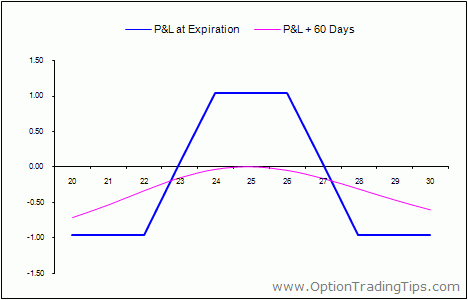
Components
Long ITM Option
Short ITM Option
Short OTM Option
Long OTM Option
A condor is very similar to a butterfly strategy. The difference is that the middle strike of the butterfly is split into two strikes.
Example: Long 97 Call, Short 99 Call, Short 101 Call and Long 103 Call.
Risk / Reward
The best way to look at the risk/reward of a condor is to break it down into two spreads. When you do this, you will notice that a long condor, which is made up of call options, is actually two call spreads - a long call spread and a short call spread. In other words:
Long lower strike call spread
Short higher strike call spread
Max loss: Limited. The maximum loss of a long condor occurs at the wings of the option spread. It is the minimum of the difference between the lower strike call spread less the higher call spread less the total premium paid for the condor.
Max gain: Limited. The maximum profit of a long condor will be realized when the stock is trading between the two middle strike prices. When you look at the Condor as 2 call spreads, take the one that has the maximum distance between the strike prices, subtract the net premium paid for the spread and that is the max loss.
An easier way
It's a bit cumbersome to think of a condor this way in order to determine your profit and loss points. A faster and more accurate method is to use a spreadsheet like the one below:

Just enter the strike prices and option premiums into the top left input box to define the legs for the combination and the graph will update with the profit and loss.
Characteristics
Just like a long butterfly, Long Condors are used when an investor believes that the underlying market will trade in a range (sideways) up until the options expire.
Condors are best used when the options are close to expiration. If the options are longer dated then the underlying asset has more chances to break away and trade outside of the boundary exercise prices.
klutzJanuary 27th, 2015 at 11:39am
https://www.optiontradingtips.com/strategies/long-condor-payoff.xls shows
Call Call Call Call
1 -1 -1 1
Labels should include Puts.
PeterNovember 14th, 2011 at 4:48pm
12 points per side seems excessive. What broker do you use? Interactive Brokers would charge $1 per side max. Less if you do more volume. See IB Commissions for details.
bhupalNovember 12th, 2011 at 9:42am
this wont work on most of the intstances.
example you sell dow at 12000 with a premium of
110
call + put 220
you buy put at 83(11900)
you buy call at 83(12100)
difference is 220-164= 56 maxiumum profit.
however most of the brokers offer with high brokerage. you need to pay 12 point diffence for by and sell
say you paid 48 brokerage
the maximum proift is 56-48=8
you need to spend hell lot of time to arrive at this scenario
devendra shahSeptember 14th, 2010 at 11:48am
Pl give example that we could enter in which strike price and which time(if expiry period near or far )because i cant understand ..suppose image stock price r currently 5800 so can i which strike price and which call and put buy and sell
PeterSeptember 12th, 2010 at 9:49pm
Sure - to build an Iron Condor you would short the strangle with a downside call and upside put. Then to build the wings you would need the protection of a long downside put and long downside call. E.g.
Long 98 Strike Put
Short 99 Strike Call
Short 101 Strike Put
Long 101 Strike Call
gaurav tandonSeptember 12th, 2010 at 3:43pm
may i know, how the wings should be created of the strategy mentioned by jason.
(short strangle with wings). thanku
AdminJanuary 2nd, 2009 at 6:49am
Thanks for the input Jason! I'll make a mention of that and include an Iron Condor example.
OffFloorOPTraderDecember 26th, 2008 at 1:32pm
Your description of the condor is accurate, except for one slight discrepency. You say, also known as the Iron Condor. In my experience as a prof. trader IRON Means calls AND puts in combination. Therefore, an IRON condor would be a short strangle (call & put) with wings to protect potential lost. Thanks,
Jason
Add a Comment