Long Put Option
| B/S | Strike | Type | Price |
|---|---|---|---|
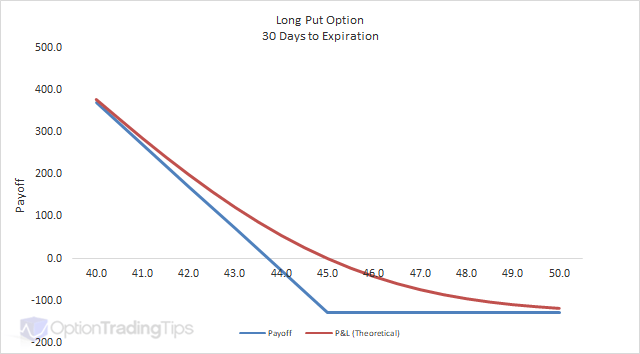
| Buy 1 | $45 | Put | $1.29 |
| Net Debit | $129 | ||
A long put is the purchase of a put option.
The Max Loss is limited to the net premium paid for the option.
The Max Gain is uncapped as the market falls but limited to the strike price minus the stock price as the stock cannot trade lower than zero.

PeterOctober 9th, 2014 at 5:08pm
Hi Ron,
No, but you will have to sell the stock at the strike price. If you don't already own the shares then your broker will borrow the shares on your behalf and then sell those shares to the seller of the put option.
You will then have a "short" position of shares in your account (traded at the strike price) that you will have to buy back at a lower price in order to make a profit.
Ron easleyOctober 9th, 2014 at 9:26am
I have a long put option at 75 and at the strike date completes and the stock price is 72. Will I have to buy the stock at 75? Don't know much about options.
PeterAugust 4th, 2014 at 12:26am
Hi Jamaal,
Option prices (premiums) will fluctuate in response to changes in factors such as underlying price, volatility, time decay and interest rates. The price of the option can rise after you have purchased it providing you with an opportunity to profit by selling it back to the market at the higher price - instead of exercising it or waiting for the option to expire before exercising.
Does this answer your question?
jamaalAugust 3rd, 2014 at 10:13am
Hi,
Whats happens if the long put position rises more than the premium paid but then it starts declines in prices before expiry? In other words can a worthless long put contract turn to profit?
-Jamaal
[email protected]
PeterMarch 26th, 2014 at 3:33am
Hi Russ, this will be because the implied volatility of the option has decreased by a magnitude greater than the effect of the delta (underlying price change).
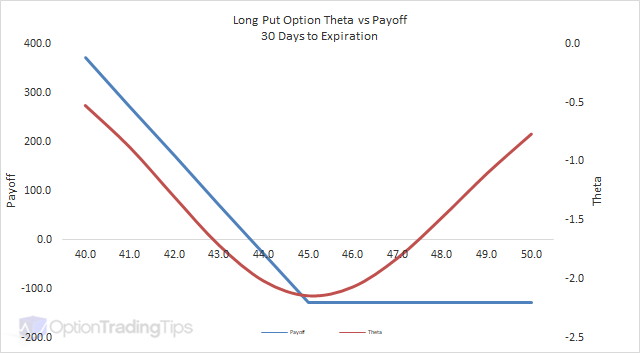
Volatility is a major component that makes up the price of the option; higher volatility means higher option prices, lower volatility means lower option prices. Perhaps the volatility was relatively high when you bought the option only for it to decrease post purchase?
Steve_AMarch 14th, 2014 at 11:27am
Thanks Peter, clear now.
RussMarch 14th, 2014 at 9:23am
I have a question, i brought a put for a strike price of $40 and exp date of 3/22
XYZ is currently down to $34 a share. why am i showing a negative amount next to my put purchase? i brought the put when the stock price was at $42
[email protected]
PeterMarch 11th, 2014 at 4:27am
Hi Steve_A,
Please have a look at the page on Payoff Diagrams.
Let me know if anything is not clear and I'll update the page with your feedback.
Steve_AMarch 8th, 2014 at 3:31pm
Hello Peter. You have a knack for explaining complicated terms and scenarios in a digestible fashion; thank you. Can you point me to a resource that will help me to understand the P/L graphs? I'm just looking for a general understanding of the graph.
PeterSeptember 13th, 2013 at 8:40am
Hi Brian, yep, I see what you mean for long puts - your profits are capped at the strike - stock price. For a long call, however, your profits are limited only to the price that the stock can rise to. "Unlimited" profit for long profile graphs like this has just been the convention used since I've been learning about options. I would say that it is used to provide some context on a likely move for a stock i.e there is no immediate "cap" on your profit - it will ride as long the stock trades in your direction. Sure, if you're long a put at $1 like you say and it free falls to zero, that would be your limit though.
brianSeptember 12th, 2013 at 10:17am
I'm really confused about this claim of "unlimited profit." Lets say a stock is trading at 50 and I buy a long put with a strike of 40. Lets say the option costs me $1. If the stock goes to zero (which is as far as it can go), my profit is $39. As a percent, this is 39/1 or 3,900%. It still isn't infinite. No one sells you an option for free. Where is this idea of infinite profit potential coming from?
PeterMay 7th, 2013 at 11:45pm
Hi Larry,
If you think that volatility will play a lager role in the SPY than the price then I would say you would be best buying the near term at-the-money put option.
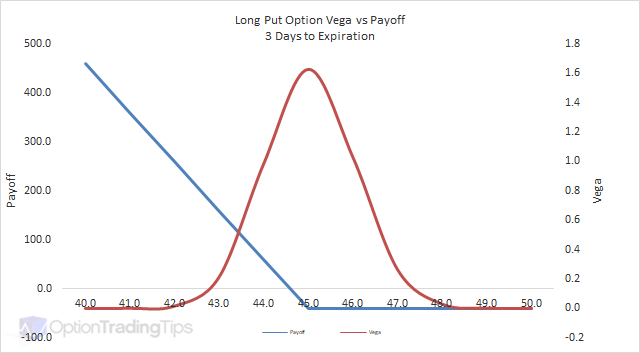
Near term options are more sensitive to changes to volatility.
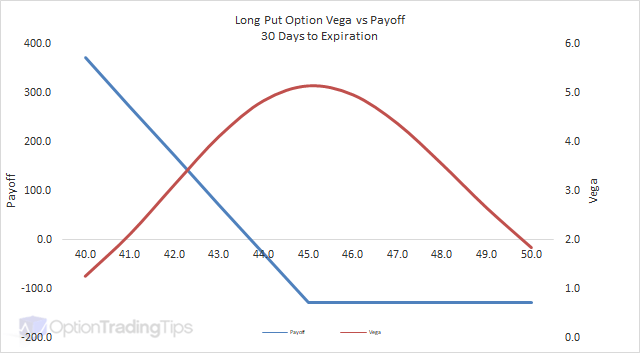
However, you should also consider how far you think they market has to move in your favour. Vega (or price change due to volatility) is highest for ATM options so as the market does move more in your direction it may move past the strike. So, another suggestion is to buy a put option that is slightly out-of-the-money so that as the market approaches your strike level you get maximum change in premium due to volatility changes.
LarryMay 7th, 2013 at 12:56pm
Hi, I am interested in buying two put options for SPY, since I think it will go down with strong volatility, with one option with 6 months and the other 1 year expiry. But how do i choose different strike prices because with the same expiry date, one strike price higher 5 dollars but the option price is only 3 dollars more expensive? I know it has something to do with time value. How do I choose the best strike price?
PeterAugust 2nd, 2012 at 6:02am
Hi Kevin,
Sorry for the delay in responding! I saw your post and thought it would take more thought to respond so I put in the "too hard basket" ;-)
However, upon re-reading it I'm not sure I follow the posters' strategy.
If you buy 3 calls for $1.12 and 3 puts for $1.56 then the max loss is $804 (3 * 1.12 * 100) + (3 * 1.56 * 100).
Also, XYZ seems to be a fictitious stock so I don't see how I can confirm the price changes and option prices ;-)
KevinJuly 10th, 2012 at 12:53pm
Peter,
I copied this from another poster in your blog here. My question is this, as this is the style of spreads I am looking into making myself, these numbers don't add up to me. Can you explain in laymans terms what this guy did and how it works to profit either at or just before expiry???
I just got finished using the P/L Calculator on optionshouse paper trading and tried a couple different combinations, one in particular that i would appreciate some insight on. XYZ is trading at $40, and purchasing 3-$39 calls @$1.12 and a 3-$41 [email protected]. From 40 to 41.36 its a loss(max $36), looking at the monthly chart the stock has moved in a $2.50-$4 range for the entire ytd. $804 total investment; $2-$4 down returns $300-850; $2 up returns $100-$650. The problem here is it seems to good to be true. Am I misinterpreting something OR does that sound about right?
PeterJuly 6th, 2012 at 10:30pm
Hi Konstantin,
Thanks for the feedback on the site! I am trying to make it a little cleaner with the new layout.
Using options really depends on your objectives. If you hold stock and wish to gain some extra income in return for giving up some upside potential then covered calls might suit. If you want to buy a stock at a lower price within 2 months and get paid for that then you might like shorting puts.
If, like you asked, want to just make huge returns punting on market direction then you are best placed buying and selling options (just trading them) as if they were stocks. But you will need to have a view of the market i.e. going up or down to do this sucessfully. Using options this way provides a lot of leverage or bang for your buck with your money.
KonstantinJuly 4th, 2012 at 7:11pm
Hey Pete,
First, love your new style of website great job :)
Ok, I'm use to trade Future Contract, and is very easy to sell and Buy. But now, i'm looking to go to my TFSA and RRSP account to trade and get tax free :) money ( Love Canada System:)) but...you guys, have more complicated stuff in Options:p
I trade my first Put option past week, you will notice I did many mistake but how ever...I make some money :) and this why I have question for you.
so my trade was :
-42 1contract-PUT-ATM pay price of 2$ total 200$.
-It drop to 40, was looking to get out. at this price. for quick cash :)
-But I wasn't able to buy...or I din't know how at 40$ those 100shares to get 200$ profit on than.
-So I sold my 1c option for BIT price 3$
-I make 100$..-9.95$ contract...was happy to make 40% but still...
So my question it's....
-how do I use options for maximum profit...do I have to sell/buy as a shares automatically? or As an options?
-to short a stock...with minimum risk ( to my cost of options...in this case 200$)... what do I have to use? Long put option? and to go long,Long call option?
-This what I was expect to do in future in options and can I? and if yes how?
1st-Buy Put 10option at 10$ for 1$/share.
2nd-Sell 6 option/600share at 8$ to get easy income
3rd-Use stop order at 9$ for 2option/200shares to lock in profit.
4th- sell 2options/200shares , at next target price and Celebrate all day :)
PS: I'm an analyses trader,I'm doing very very well on see the market direction on short/long terme...and this why I want to use simple strategy to ATM Put or Call, but with minimum risk and low capital (this why options)
So hope I was clear enough :)and tnx a lots for your help
Konstantin
PeterMarch 26th, 2012 at 6:52pm
Hi Kuruvilla,
No, I think Vishal is saying that he was originally the buyer of the put and then he wishes to close the put by selling back to the market. In that case the counter party will be another option buyer.
KURUVILLAMarch 14th, 2012 at 2:50am
Am studying about options.Hello Peter,let me clarify a doubt about a question put up by Vishal on 1st November,2009.Is not the answer would be like "the seller or writer of the option ".Please clarify.
PeterJanuary 2nd, 2012 at 4:41pm
Hi Shawn, that's seems fine to me - that is the power of leverage and the main reason retail traders use options. But, you can also lose those amounts (or your entire premium) if the market goes against you.
ShawnDecember 30th, 2011 at 12:54am
I just got finished using the P/L Calculator on optionshouse paper trading and tried a couple different combinations, one in particular that i would appreciate some insight on. XYZ is trading at $40, and purchasing 3-$39 calls @$1.12 and a 3-$41 [email protected]. From 40 to 41.36 its a loss(max $36), looking at the monthly chart the stock has moved in a $2.50-$4 range for the entire ytd. $804 total investment; $2-$4 down returns $300-850; $2 up returns $100-$650. The problem here is it seems to good to be true. Am I misinterpreting something OR does that sound about right?
BevNovember 10th, 2011 at 1:56am
Thanks for shedding MUCH needed light on that and guidance to other means to close a position.
PeterNovember 2nd, 2011 at 4:55pm
Hi Bev,
Sure, you can wait until the expiration date and exercise the option but this will require capital to take on the position. However, you won't have any trouble getting out of the position if you really want to.
The option market makers will always be there to take the other side of your order. If there isn't a bid ask market there you can perform a "quote request" (if the market and platform supports it) where market makers will respond with a double sided quote.
If not, then you can place an order yourself and adjust it until someone takes it. Once the order is priced above the option's intrinsic value you will definitely get hit on it.
BevOctober 31st, 2011 at 5:26pm
I have bought long put contracts on a stock currently selling for 8 dollars. It is expected to easily move down to 6 dollars or less. I bought 40 contracts at 1.00 (100 dollars a contract) and the current open interest including mine is now 119 contracts. Not a lot of volume in other words. For such inexpensive stocks (and currently low open interest) is there a point you had best sell? In other words, say I held the option until it went down to 4 dollars. Who would buy this now expensive put option from me for say 3 dollars when they can just short the stock itself for 4 dollars?
Or can I hold it until it would reach the 4 dollar mark and then exercise it? Using an online trading platform, how do you actually exercise it? I have only closed the option contracts in the past so not sure how that works?
Great site by the way - most appreciated.
MAHENDRA KUMAROctober 28th, 2011 at 11:30pm
Buying put is the opposite of buying a call. When you buy a call option you are bullish about the stock/index. When an investor is bearish he can buy a put option. A put option gives the buyer of the put option a right to sell the stock (to the put seller) at a pre-specified price and thereby limit his risk.
PeterOctober 19th, 2011 at 4:18am
No, that's the advantage with buying options - your maximum loss can only be the premium paid when you bought the option.
DaveOctober 18th, 2011 at 7:12am
I purchased (BUY) a put option that is about to expire worthless. I wanted the price to drop when I bought the put, and it didn't it went higher... I do not own the underlying stock. Is there any more risk of loss if this position expires other than the cost of the initial trade?
PeterSeptember 29th, 2011 at 5:48pm
If the option is American Style then it can happen either at expiration or when the buyer of the option chooses to exercise.
If the option is European it only happens at expiration.
AppleboxSeptember 29th, 2011 at 1:00pm
Question on selling puts...
Am I put shares when the strike price is met automatically? Or does this only happen at expiration?
Thanks!
BobSeptember 9th, 2011 at 10:25am
Great info Peter, thank you.
Also, I had another put of mine on my mind when I wrote that last post. But the put I was referencing to you is actually a two letter designation for a german bank, just so I haven't thoroughly confused you or anyone.
Thanks again!
PeterSeptember 7th, 2011 at 7:52pm
You can exit the trade whenever you like - not just when it hits the strike price. It depends on your view of the stock - if you think it will continue to trend lower, then hold onto it. Or maybe sell half of your position when it hits the strike and keep the rest open (if you have more than one contract on it that is).
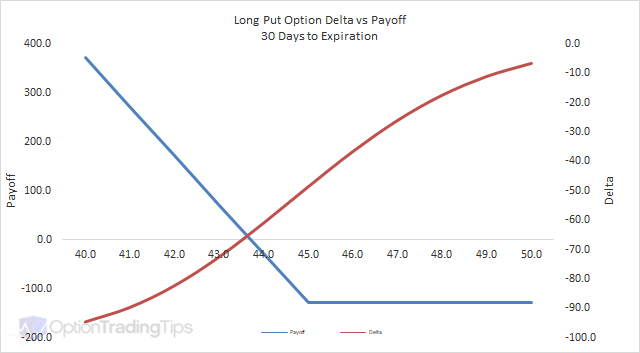
Once the stock trades below the strike the delta (and hence your equivalent stock position) will start approaching -1 meaning that the lower the stock goes the more value your position will make or lose.
BobSeptember 6th, 2011 at 12:18pm
Thanks Peter!
If it helps, I'm using rounded numbers for GS stock price, which was 36 Friday and now is trending down to 32 or so at market open today.
My put is for a strike of 30, which we're now getting pretty close to. So I can take good profits now as it's dropped from 40 to 32 on my 30JanP.
What happens to my put if I keep holding if the stock goes below my strike price of 30 (since I still have several months till expiration)? As the stock price goes below my strike of 30, does that mean I keep making more profit as there is still someone on the other side of the trade (now buying a call up to 30)? Or is it best to get out once I reach the strike price?
Thanks again!
PeterSeptember 5th, 2011 at 5:47pm
Hi Bob,
Hard to say exactly...it really depends on the market prices for those options at the those times. But I would say that a 25% OTM put option with 3 months to expiration (without knowing volatility of course) would be a very low priced option. At this point if my decision (again, without knowing the volatility) was to get out after a $5 move after one month or get out with 10 days to expire if the stock were to reach the strike, then I would take the later option for sure.
You can play around with these numbers yourself using my option pricing spreadsheet.
As you are the buyer of the option you have the ability to decide whether to exercise or not, so yes, you can hold onto the option as the stock price moves lower.
BobSeptember 5th, 2011 at 12:39am
I'm new to options trading and have a basic question. If I'm using a long put, current price is $40, and I buy a put for a strike at $30 in three months:
1. is it better to sell in one month's time if the price only drops to $35 (take returns and get out profitable essentially), or better to wait for it to hit strike price of $30 closer to the three months' option time? (assuming belief is that it will indeed continue to drop)
2. can I hold if the price continues to travel lower than my $30 strike price limit or would I have been required to sell at the strike price of the option?
PeterAugust 16th, 2011 at 7:27am
Sorry - I don't understand your question. Could you elaborate please?
hussainAugust 16th, 2011 at 2:15am
How I can differentiate put and call option under long and short term?
PeterDecember 8th, 2010 at 10:48am
It depends on what you're trying to achieve...are you talking about a call or a put?
kavithaDecember 8th, 2010 at 3:22am
I am beginner of option trading so I need to one clarification
which strike I sell & buy the option ex: nifty current level 5865
pl explain with example
PeterSeptember 12th, 2010 at 10:03pm
The broker can't stop you exercising - it is up to the clearing corporation/exchange. In the US this is the OCC (Option Clearing Coporation).
Whether you are able to go "short" the stock can be up to both the broker (to manage client risk limits) and the regulators (US banning all short sales).
Stock borrow would not come into it because if you exercise your put you can just buy the stock in the open market at the going price and deliver it (sell) to the put option writer at the strike price (a stratch trade on the stock).
kenJuly 14th, 2010 at 2:31pm
I have been trying to get this answer If you buy a put and the stock is hard to borrow will the broker prevent you from exercising? or will they automatically cover the position at the close? or do they let you exercise and commit a naked short?
PeterJuly 7th, 2010 at 7:44am
Hi Raj, if you take a look at the payoff graph above for a put option it will show you how the price of the option changes when the stock price changes. A put option will gain value when the stock price declines, which is the opposite of a call option. A call option rises in value as the stock price inceases.
RajJuly 6th, 2010 at 11:39pm
Hi, I am beginner in the options trading. Need help in understanding the call and put. I assume the call and put price will go higher with price of stock coming a strike price. Taking a example of stock XXXX at strike price [email protected] put but trading at 500... As the stock price of XXXX come downd... put go higher... is this correct?.. please explain with an example
PeterJune 28th, 2010 at 6:53pm
Hi Hvete, it's not a stupid question at all...it's good that you asked.
The key to understanding options is that they carry the "right" to buy/sell an asset - not an obligation. If you have bought an option and do not wish to "exercise" it, then you simply allow the option to expire and all you lose is the premium paid.
This is why there is no mechanism to ensure that you hold the stock when you buy a put option. However, if you have bought a put option with a strike price of $25 and the stock is trading at $20 at expiration then why wouldn't you go and buy the stock and exercise your option for an immediate gain of $5 per contract? (some brokers will automatically borrow the stock for you if you exercise an option with collateral).
To answer your last question...the buyer of the option have the "right" to exercise but the sellers of the option are "obliged" to exercise. I.e. the sellers don't have the choice...if you decide to exercise and sell the stock, the seller of the option has to buy the stock from you. That is why the buyer pays the premium to the seller.
HveteJune 27th, 2010 at 9:13pm
Additional stupid question. Suppose I have a put option that gives me the right to sell IBM stock at $40 a share (assuming we can get around the problem that I don't own any IBM stock). How can I have a right to sell if no one wants to buy, and surely no one will want to buy if IBM is trading at $35.
HveteJune 27th, 2010 at 9:08pm
So here's the really stupid question. One thing I keep trying to get my head around is this. A put option gives me the right to sell a stock at a certain price. How can I have the right to sell a stock if I don't own it? So if I do own it, and every time you buy a put option, there's some mechanism to affirm that I own the underlying stock? If I own the stock, I can't see any terribly good reason to buy a put option. If I don't own the underlying stock, how can I sell what I don't own? So I read that I borrow the stock. Borrow the stock? Like I borrow your house and sell it? I can't borrow your house and sell it and then buy it back... at least not without your permission. So why does anyone grant permission to lend their stock so someone can play games with it? What's in it for the real owner of the stock?
PeterJune 21st, 2010 at 7:44pm
If the option specifications are set for physical delivery, then I guess it depends on your situation with your broker. They may borrow the stock on your behalf to on-sell to your counterparty who is short the put option.
If the option is cash settled (i.e. most index options) then no asset is transferred.
Also...if you are long an in-the-money put and you know that you don't have enough funds to cover the stock purchase, then you would just sell the option prior to the expiration date and realize the gain that way.
mariaJune 14th, 2010 at 5:06pm
What will I receive if I exercise a long put and I have no assets?
PeterNovember 7th, 2009 at 5:17am
Hi Vishal, other speculators who are still bearish on the stock, market makers, investors hedging their long stock or option traders who are buying puts as part of an option combination are examples of who would be buying the option from you.
vishalNovember 1st, 2009 at 11:19pm
let us say i have put option and during bearish market i want to use my put option to earn profit, at that time who will purchase my costlier put option (even if i have right to sell) as the price movement is downwards. plz help
PeterAugust 20th, 2009 at 9:11pm
It would only be 40/0 if you paid 0 for the option.
StanAugust 18th, 2009 at 8:06pm
You don't need negative stock prices for unlimited profit potential. When expressed as a percentage, if the underlying stock goes to zero, your gain is infinite. If the current value of the stock is 50, you buy a put with a 40 strike and it goes to zero, your gain on the option is 40/0, or infinite percent.
sarbjitJuly 26th, 2009 at 3:37am
Dami,
yes, we can hedge a scrip to decresing in value through long put option.
DylanJanuary 4th, 2009 at 12:45pm
The profit potential of a long put option is only unlimited if negative stock prices exist.
AdminJanuary 2nd, 2009 at 6:42am
Hi Yonis, not sure what you mean. Long refers to a purchase and Short a sale...not long and short term. Hope that helps.
yonisDecember 24th, 2008 at 2:59am
how i can differentiate put and call option under long and short term?
AdminSeptember 25th, 2008 at 6:06pm
Yep, that's a strategy called a Protective Put. Please see the link under Bullish category.
DamiSeptember 24th, 2008 at 10:37pm
Don't we use long puts to protect a stock we currently own from decreasing in value.
Add a Comment