Buying a Call Option
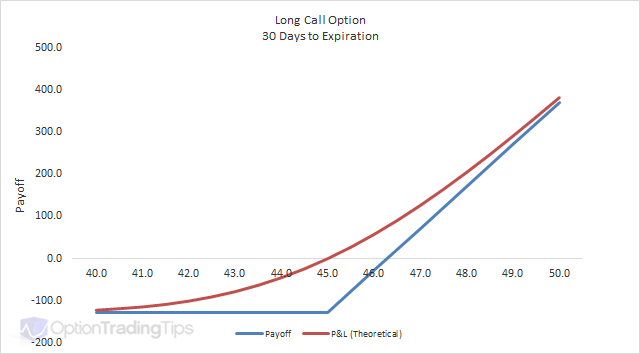
| B/S | Strike | Type | Price |
|---|---|---|---|
| Buy 1 | $45 | Call | $1.29 |
| Net Debit | $129 | ||
A long call option gives the buyer the right to buy the underlying asset at the strike price. The option buyer pays a premium for this right to the seller of the option.
The Max Loss will only ever be the premium that is paid up front to buy the option.
The Max Gain is uncapped and will rise with as long as the underlying price rises.
Characteristics
When to use: When you are bullish on market direction and also bullish on market volatility.
A long call option is the simplest way to benefit if you believe that the market will make an upward move and is the most common choice among first time investors.
Being long a call option means that you will benefit if the stock/future rallies, however, your risk is limited on the downside if the market makes a correction.
From the above graph you can see that if the stock/future is below the strike price at expiration, your only loss will be the premium paid for the option. Even if the stock goes into liquidation, you will never lose more than the option premium that you paid initially at the trade date.
Not only will your losses be limited on the downside, you will still benefit infinitely if the market stages a strong rally. A long call has unlimited profit potential on the upside.
Long Call Greeks
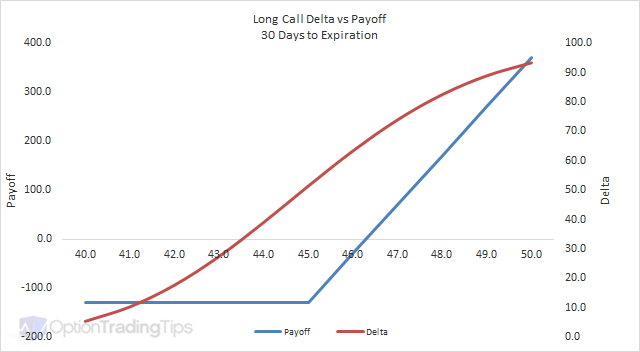
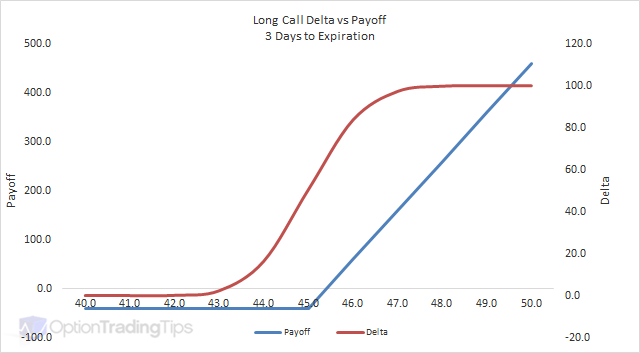
Delta
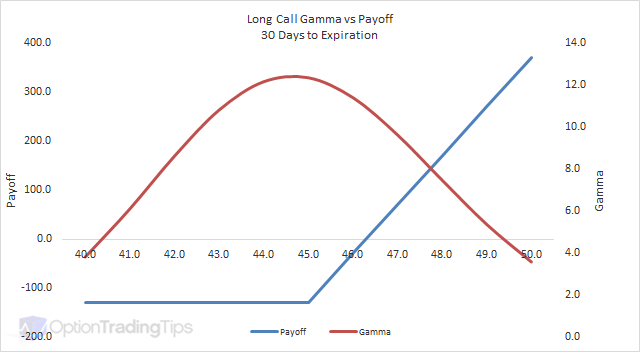
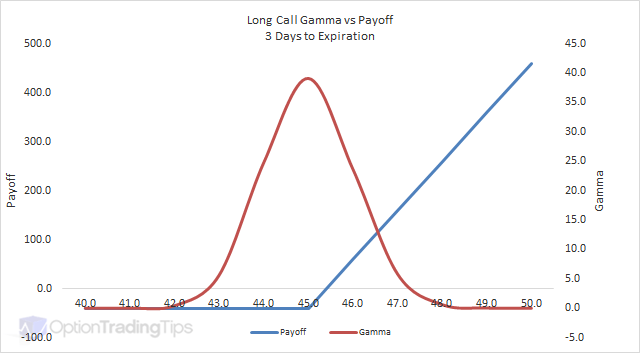
Gamma
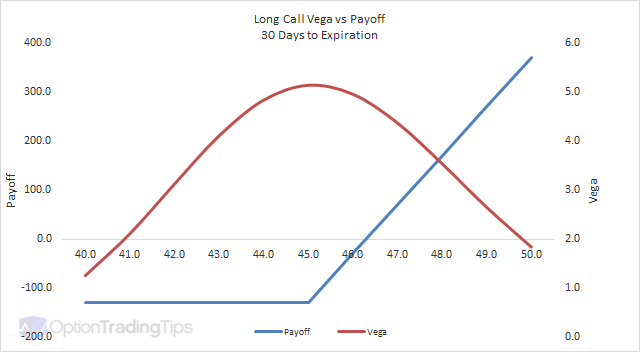
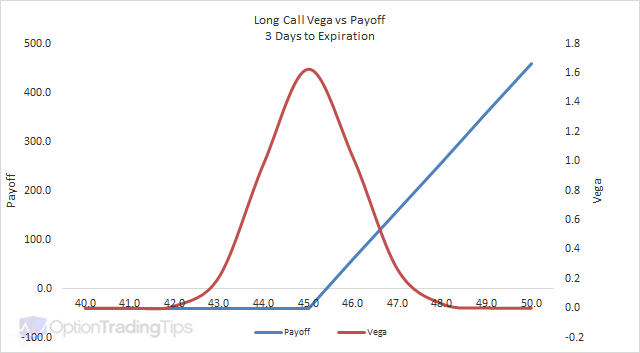
Vega
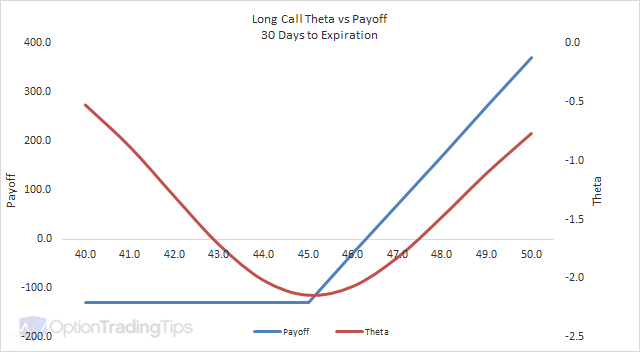
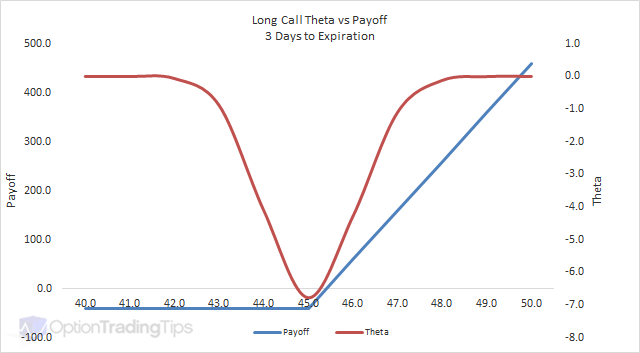
Theta
201 Comments
Annu October 10th, 2011 at 2:46pm
Hi Peter,
If I buy a call option at 5 and it is trading at 4 but before expiry date. If I sell the option at 4 so I would get premium back or not.
Annu
Jonathan September 29th, 2011 at 7:51pm
That's exactly the part I wasn't sure about, thank you very much for clearing it up.
Peter September 29th, 2011 at 12:21am
Hi Jonathan,
I think the part that you are confused about is the selling of an option for which you already have a position in.
If you buy 1 option contract then you have a long position. If you sell the same contract then you have zero position i.e. nobody can exercise against you.
If you sell an option first, without previously having a position, then you will have a short position - or be short an option. It is only when you are short an option can you be exercised against.
In your example, you've had a long position but sold to close the position - therefore you cannot be exercised against as you no longer have a position.
Does that make sense? Or have I confused you ;-)
Jonathan September 28th, 2011 at 9:37pm
I was wondering if you could help me with the following question.
I know that options that expire in the money are automatically exercised at expiration. So if you hold a call option in the money, you have a choice: exercise before expiry, sell the option, or let it expire and it automatically gets exercised. I've read a bunch of stuff online saying that it is usually better to sell the option rather than let it expire because you get the added profit from the premium, unless you want to hold the stock longer. In that case you might as well let it expire and then you get the shares at expiry for the strike price. So here's my question: if you sell the option before expiry, isn't there a high risk that the person who buys it will exercise it against you, either by exercising it themselves or letting it expire? And wouldn't that end up costing you money?
Here's an example: I buy a 30 call on RIMM for say $1.50 and as expiry approaches the stock is trading at $36. At that point let's say the option is worth $5. If I let it expire, I automatically purchase RIMM at $30 - at which point I can sell it at $36 for a profit of $6/share. If I choose to sell the option, I profit $5-1.50 for $3.50/share. But if someone else buys my 30 call for $5 when the stock is trading at $36, there is a very good chance it will be exercised - which means I would have to buy the stock at $36 and sell it to that person for $30, for a loss of $6/share. So although I profited $3.50/share on the option sale, I come out behind when the option gets exercised against me. So why would I take that risk? Or am I missing something here?
Peter September 9th, 2011 at 7:57am
Thanks Michael, I am affiliated with Option Sizzle and will let them know about the error, thanks for pointing it out! Peter.
Michael T September 9th, 2011 at 3:48am
Just an FYI - When I went to the the home page of the site you (Peter) suggested for option ideas (optionsizzle.com) I got a message from my antivirus software that it blocked an exploit. Meaning the site was trying to do something it shouldn't be.
If you are affiliated with the site, you should let them know. If it's a legit site, then they should investigate the error.
BTW - I'm very impressed with your ability to answer all of these questions. Really enjoy the q&a.
Peter August 31st, 2011 at 7:03pm
No, you don't earn on both. But it's a good question.
If you are still holding the call option after the stock has been taken over then you can sell out of the option to close the position and your profit will be the difference between the sold price and the purchase price. With the prices you mentioned the call would be worth at least $7,800 per contract ( (150 - 72) * 100). If you paid .25 and sold it for 78, then your profit would be 1,555,000 ( (78 - .25) * 100 * 200).
Alternatively, you could choose to exercise the option, which means you would have to buy 20,000 shares at the strike price. If the strike price was $72 then you would need 1,440,000 in capital to cover the exercise. Then you would sell the shares at the market price to make your profit. Your existing option position would be sold at zero and the price paid initially has already been received by the option seller.
Hope this makes sense - let me know if anything is unclear.
Rah August 31st, 2011 at 12:13pm
I I bought call options 200 contracts for $25 per contract or .25 per share 20,000 shares betting that the stock will be bought out. Strike price is $125 for sept calls. Current price is $72. If the company is bought out next week and the stock goes to $150 do I make the value of the call plus $30 for every share I am holding which would be $600K plus??
Thanks!
Peter August 29th, 2011 at 9:44pm
You'll be buying the stock at $13 - the strike price.
Tom August 29th, 2011 at 8:09pm
Peter,
I had one more (probably silly) question.
If I buy a call option of stock XYZ (trading at 10) with a strike price of 13 (say expiring in 120 days), and this stock hits 14 before it expires, and I decide to execute, am I able to buy the stock at 10 (the price at which I bought the call contract) or at 13 (the strike price)??
Thanks for your help!!
Tom
Add a Comment