Buying a Call Option
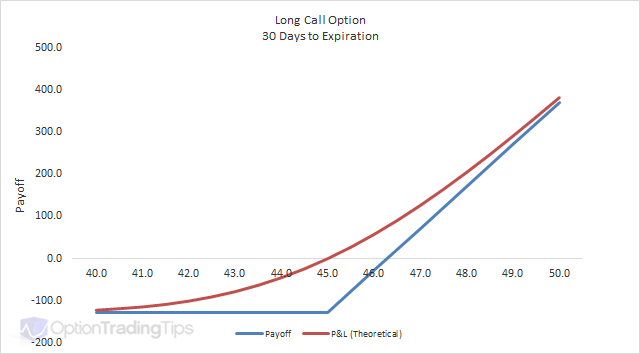
| B/S | Strike | Type | Price |
|---|---|---|---|
| Buy 1 | $45 | Call | $1.29 |
| Net Debit | $129 | ||
A long call option gives the buyer the right to buy the underlying asset at the strike price. The option buyer pays a premium for this right to the seller of the option.
The Max Loss will only ever be the premium that is paid up front to buy the option.
The Max Gain is uncapped and will rise with as long as the underlying price rises.
Characteristics
When to use: When you are bullish on market direction and also bullish on market volatility.
A long call option is the simplest way to benefit if you believe that the market will make an upward move and is the most common choice among first time investors.
Being long a call option means that you will benefit if the stock/future rallies, however, your risk is limited on the downside if the market makes a correction.
From the above graph you can see that if the stock/future is below the strike price at expiration, your only loss will be the premium paid for the option. Even if the stock goes into liquidation, you will never lose more than the option premium that you paid initially at the trade date.
Not only will your losses be limited on the downside, you will still benefit infinitely if the market stages a strong rally. A long call has unlimited profit potential on the upside.
Long Call Greeks
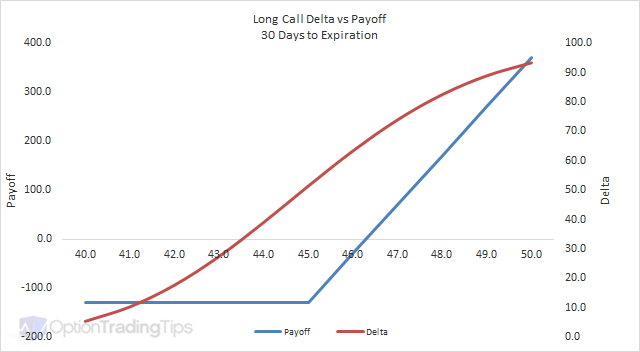
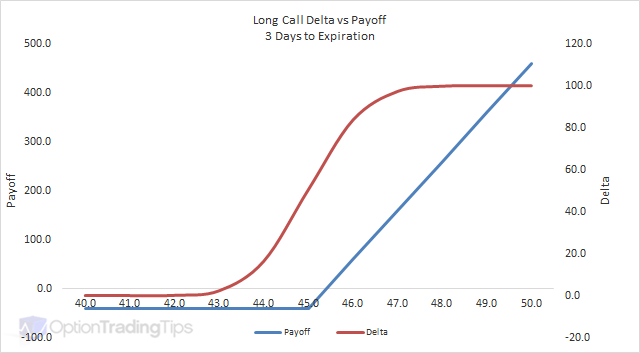
Delta
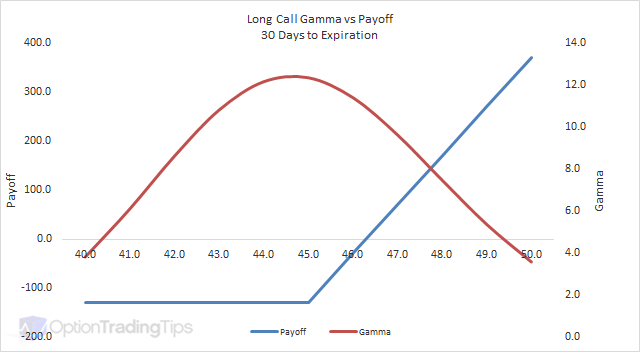
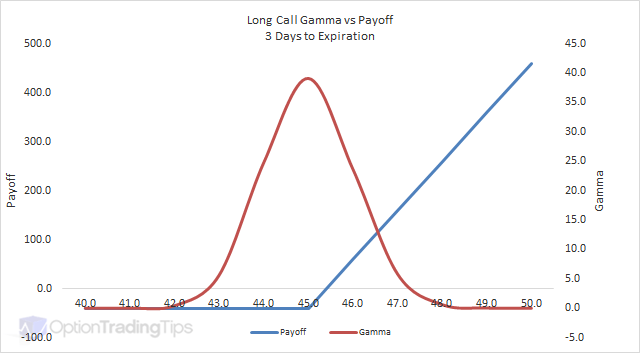
Gamma
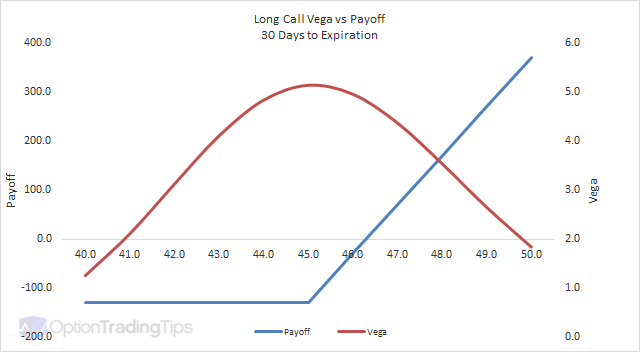
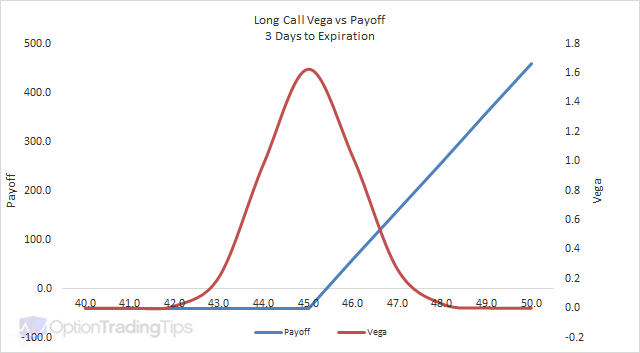
Vega
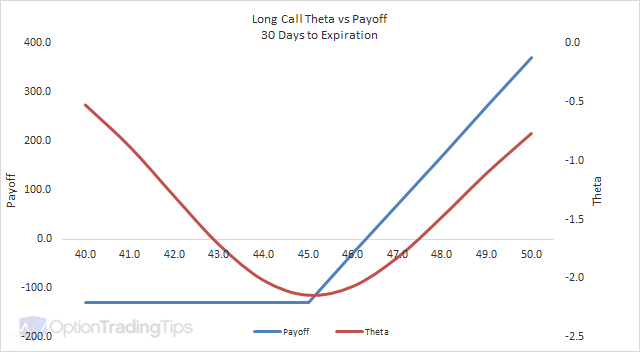
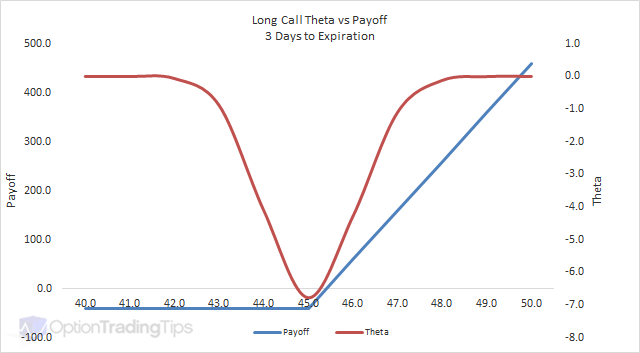
Theta
201 Comments
Marshall September 19th, 2010 at 1:32am
I am looking at YRCW Jan. 2011 1 dollar calls. currently trading at .05 how many shares would I be buying for the .05 cents? My second question is when the contracts expire in Jan 2011 and I exercise my option and purchase the the stock would I than purchase the stock at .05 per share even if the market is trading at 3.00 bucks per share when the contracts expire? How much money do you have to have in your account to buy options?
Peter August 29th, 2010 at 5:02pm
That's right...when you already have a long position in an option and you sell, you close out the position and the profit is realized instantaneously.
Adam August 29th, 2010 at 4:27pm
I think I see, so basically the first example is staying strictly in the options market and just trading contracts. Controlling 100 shares of stock (if i just bought 1 contract) without actually purchasing the actual stock and i can sell anytime before expiration and realize the profit (just as if i actually purchased the stock) except by trading contracts, it eliminates the need to purchase the stock.
However, when you sell the in-the-money option contract back, is the profit ($500) instantaneous (excluding settlement and what not)? Or is it like selling (short) a call? Where I could lose my entire premium (unlimited risk and limited profit potential), or is that entirely a separate methodology of trading? I guess im confused on the concept "sell".
Example 2 is crystal, thanks so much.
Peter August 29th, 2010 at 8:41am
Hi Adam,
There are two ways to realize the profit;
1) Sell the option contract back in the option market. E.g. let's say that the $10 strike option that you bought cost $1.50 and by the time the stock traded up to $15 the option is then trading at $6.50. Then, you would sell the option back at $6.50 and realize $500 ((6.50 - 1.50) x 100).
2) When you exercise the option you are assigned the stock at the exercise price of $10 while the stock is actually trading at $15. So, yes, you then spend $1,000 on the stock that is now worth $1,500. Now you're long the stock at $10, you would sell the stock on the open stock market to realize the $500.
Make sense? Let me know if anything is not clear.
Adam August 29th, 2010 at 12:08am
I'm trying to learn options, but im not quite understanding how you would actually realize the gains from a long call option that was exercised while in-the-money.
For example, if I purchased a call option on XYZ stock with a strike price of $10, and the stock price shot up to $15, how exactly would I physically realize the profit in my account?
Since a call option is a right to BUY the stock at the specified strike price. If I were to buy the stock at $10 (10 x 100 = $1,000) it would cost me $1,000, but the actual stock is trading at $15 (15 x 100 = $1,500) so that's $500 difference, but HOW exactly would physically I get that $500???
If I exercise the option I own 100 shares of XYZ stock at $10, if it's currently trading at $15 would have to sell it at the current price ($15) to actually realize my gains?
I just don't understand, everywhere i've looked, nobody ever says that you have to SELL the stock back after you exercise an in-the-money call option. So i guess my question is: After you exercise an in-the-money call option, what happens next? How do you get the profit?
Please help me, i can't seem to figure this out, thank you.
PS: i realize i've excluded BEP for commission and fees for simplicity.
Peter June 16th, 2009 at 6:53pm
Hi Preetha,
Are you long all 3? I.e. long the call, the put and the future? If so, your position is synthetically the same as a long call with a breakeven point at 4693.
If you're very bullish on the Nifty, you may as well hold onto the position as you are long delta and the current position will benefit from the market rising.
However, you might also want to look at selling 2 call options around the 4700 strike level. You will cap your upside potential somewhat, but lower your breakeven and also your downside losses if the market falls.
preetha June 16th, 2009 at 4:17am
I am an Indian trader. I have call @43(Nifty 4800), put @90 ( Mini Nifty 4400) and a Nifty @ 4560. The closing price of the Mini Nifty today is 4520. What can I do to secure my position next day ?
piyush saini April 28th, 2009 at 10:00am
but how it will be profitable in every condition and when one can make profit sale and purchase both than why should one do it.
Alexander Shlepakov January 17th, 2009 at 5:32pm
Remember that you can always hedge your long call position by selling a further out of the money call at the same time. Alexander Shlepakov. aka Bull Call Spead
Admin December 8th, 2008 at 3:12am
Hi HH,
A "long stock" position is simply when you've bought shares in an underlying asset. A long call option is different to a stock position in that a call option has limited risk. A long stock has a profile that looks the same as a long synthetic;
https://www.optiontradingtips.com/strategies/long-synthetic.html
Add a Comment