Buying a Call Option
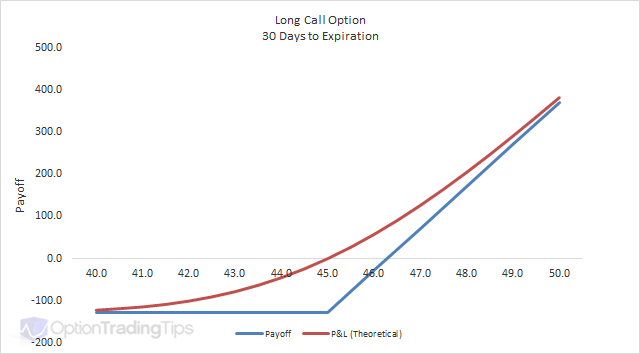
| B/S | Strike | Type | Price |
|---|---|---|---|
| Buy 1 | $45 | Call | $1.29 |
| Net Debit | $129 | ||
A long call option gives the buyer the right to buy the underlying asset at the strike price. The option buyer pays a premium for this right to the seller of the option.
The Max Loss will only ever be the premium that is paid up front to buy the option.
The Max Gain is uncapped and will rise with as long as the underlying price rises.
Characteristics
When to use: When you are bullish on market direction and also bullish on market volatility.
A long call option is the simplest way to benefit if you believe that the market will make an upward move and is the most common choice among first time investors.
Being long a call option means that you will benefit if the stock/future rallies, however, your risk is limited on the downside if the market makes a correction.
From the above graph you can see that if the stock/future is below the strike price at expiration, your only loss will be the premium paid for the option. Even if the stock goes into liquidation, you will never lose more than the option premium that you paid initially at the trade date.
Not only will your losses be limited on the downside, you will still benefit infinitely if the market stages a strong rally. A long call has unlimited profit potential on the upside.
Long Call Greeks
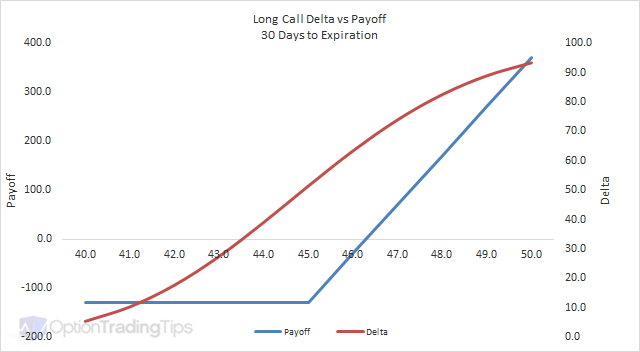
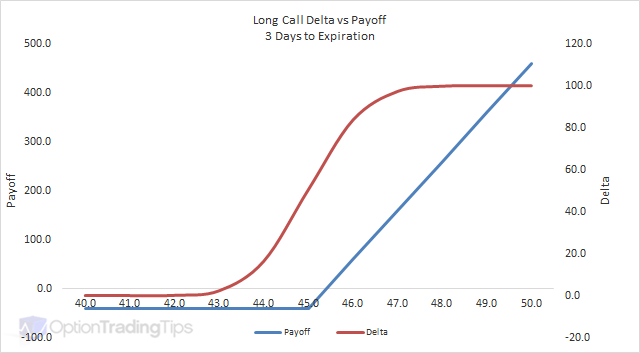
Delta
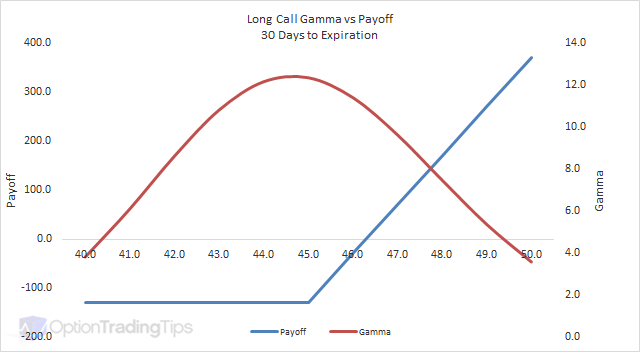
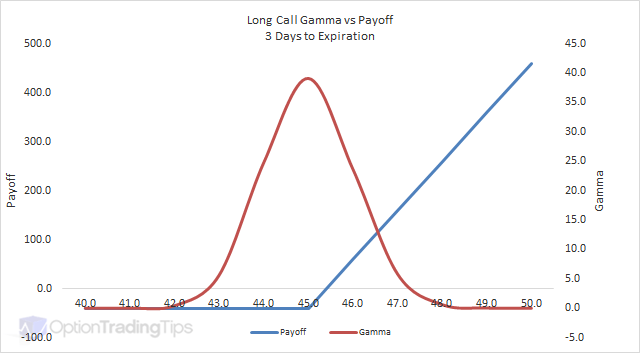
Gamma
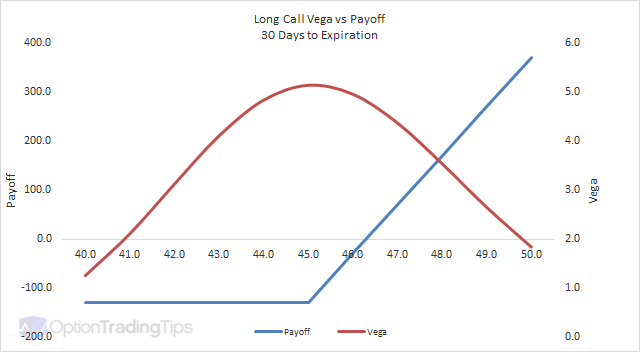
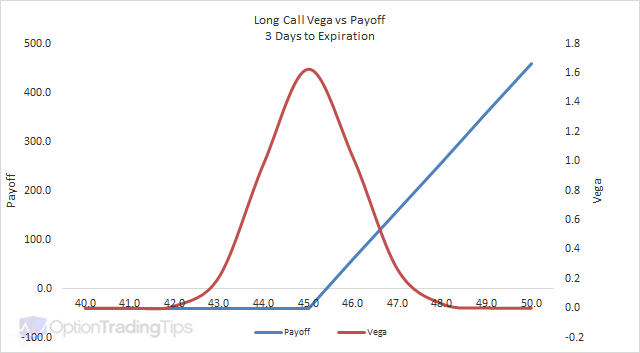
Vega
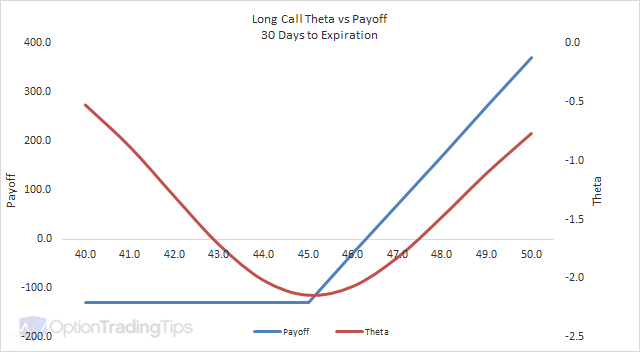
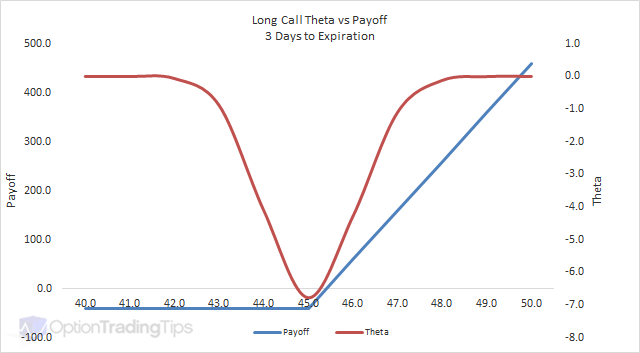
Theta
201 Comments
Peter April 22nd, 2012 at 7:39pm
Hi Lorenzo,
Yes, the implied volatility is a lot higher than where it was a month ago - over 50% higher for the puts. The calls are also higher so the market is indicating that this week will be a volatile one. I'm not sure about tanking though - if the puts were significantly higher than the calls then that I might be inclined to say that but they're both showing signs of strength.
Lorenzo April 20th, 2012 at 12:23pm
Hi Peter,
Noticing something a little unusual. I have come to like to "sell to open" AMZN put options usually the weekly on the Friday before. I usually pick a strike price around $5 to $10 under what the underlying stock (AMZN) is trading at. This week (today Friday 4/20/12) I'm noticing that the price for 4/27 puts (for $180 thru $190 strikes) is quite pricey/high as compared to what I'm used to seeing for "like" historical comps. Should I see this as a sign that Amazon is going to tank at some point prior to 4/27 expiration. Especially in light of the fact that Amazon is reporting earnings between now and then? (on April 26)...and is this "tanking" theory of mine usual for any stock (regardless whether it's reporting earnings or not) when the put prices are so inflated as compared to the prior comparable weeks?
Thanks!
Peter April 9th, 2012 at 6:02pm
Hi Curtis,
The reason that there are often two strikes listed in the same expiration month is because of Weekly Options. Weekly Options are options that are listed on the Monday and expire on the Friday of the same week.
You can tell by date, which is part of the ticker you pasted;
AAPL120413 - the first part of the ticker is the stock code followed by the expiration date, which is 13th April 2012 (120413 - YYMMDD).
Peter April 9th, 2012 at 5:52pm
Nice trade DoSSlar$! Congrats!
Curtis April 9th, 2012 at 10:11am
Hi Peter, Great advice on this site. I have a question about the following identifications. Both of these are for a buy to open call $650 strike price. The first one was selling for $3.29 and the second for $7.55. Why the price difference for contracts that are for the same strike price?
AAPL120413C00650000
AAPL120421C00650000
Thanks
DoSSlar$ April 4th, 2012 at 9:43pm
Peter,
I cannot thank-you for the basic confidence you have provided me with simplistic approach to a common person on the option, let me share the good news on my first 3 long bullish single option calls, i made on AAPL all three of them after closing gave me a net profit of average 250%, i could have held it a little longer and closed it on the March/April calls, looking at the recent increase in the volatility I decided to let it go i.e "Closed out my positions". I still feel my other options would be ok.
Peter March 26th, 2012 at 9:04pm
Hi SS,
Great trade, congrats! Yeah, it's really hard to advise as the decision to exit or continue is really up to you. Sure, there will be some time decay especially if the option is out-of-the-money and close to the expiration date. So, if you are happy with the profit so far then it might be a good idea to exit and then either buy another call further out or look for another opportunity.
Peter March 26th, 2012 at 7:35pm
Hi Edna,
If the option is physical settled, which American stock options generally are then when the call option expires and it is in-the-money, the position will be automatically exercised and converted into a stock position. That means that you will see a long stock position with a price equal to the strike price of the option.
Peter March 26th, 2012 at 6:56pm
Hi Chris,
Apologies for the late response - I was traveling with work.
Seems like a great trade there! When to get out is entirely a risk/reward decision best left up to the trader, which will be determined by your view of the market. If you think the stock still has legs then sure, hang onto them. But remember also that the more in-the-money a call option is the closer its' delta is to +1 and therefore it will move in price in the same proportion as a stock.
So, holding an in-the-money option is just like holding the stock outright.
I'd be pretty happy with a profit like that though!
SS March 21st, 2012 at 9:46pm
I am new to options but am finding it to be very interesting. My question : On 3/15 GMCR was trading at 51 and I bought Apr 55 calls at $1.80. Today the stock went steeply up and so did the call option - at one point went up as high as 5.22 and now ended the day at 3.55. I believe GMCR has more upside until Apr 21 and could well be close to 60 with the big move today. Should I simply continue to hold onto the calls or would it have been better for me to have simply sold today in the high 4s. I am mainly concerned that the time decay may erode the value of the option faster than the appreciation in stock price and am unsure how to factor this in a simple manner. Thanks again for your wonderful opinions.
Add a Comment