Buying a Call Option
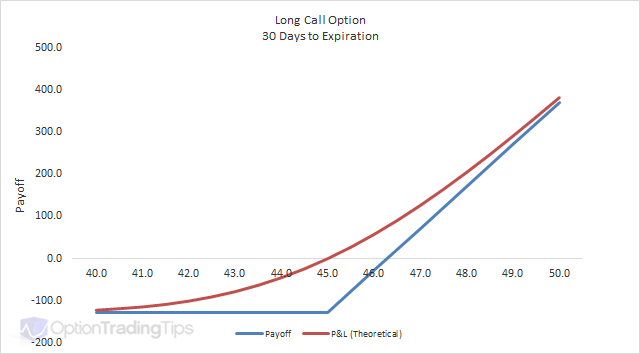
| B/S | Strike | Type | Price |
|---|---|---|---|
| Buy 1 | $45 | Call | $1.29 |
| Net Debit | $129 | ||
A long call option gives the buyer the right to buy the underlying asset at the strike price. The option buyer pays a premium for this right to the seller of the option.
The Max Loss will only ever be the premium that is paid up front to buy the option.
The Max Gain is uncapped and will rise with as long as the underlying price rises.
Characteristics
When to use: When you are bullish on market direction and also bullish on market volatility.
A long call option is the simplest way to benefit if you believe that the market will make an upward move and is the most common choice among first time investors.
Being long a call option means that you will benefit if the stock/future rallies, however, your risk is limited on the downside if the market makes a correction.
From the above graph you can see that if the stock/future is below the strike price at expiration, your only loss will be the premium paid for the option. Even if the stock goes into liquidation, you will never lose more than the option premium that you paid initially at the trade date.
Not only will your losses be limited on the downside, you will still benefit infinitely if the market stages a strong rally. A long call has unlimited profit potential on the upside.
Long Call Greeks
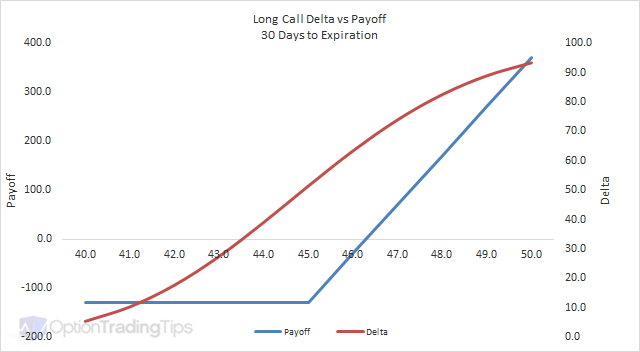
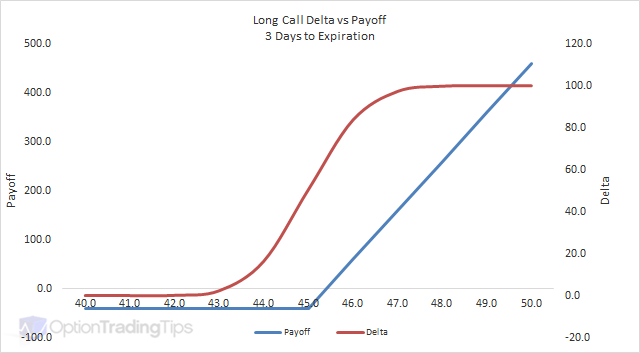
Delta
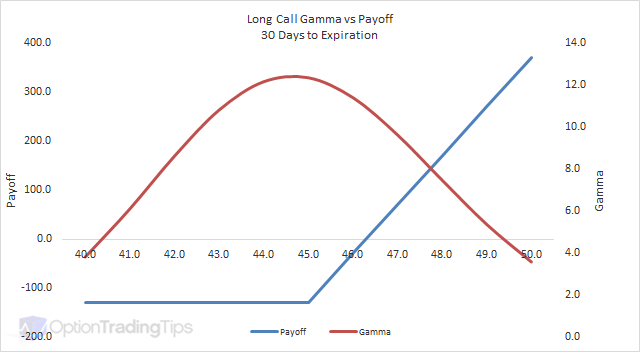
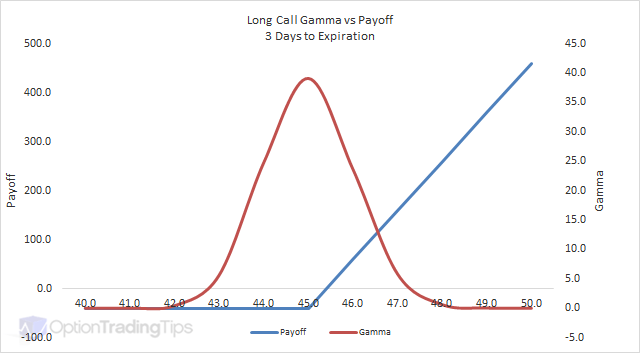
Gamma
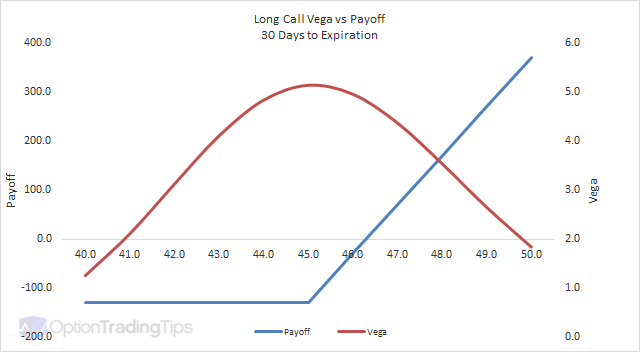
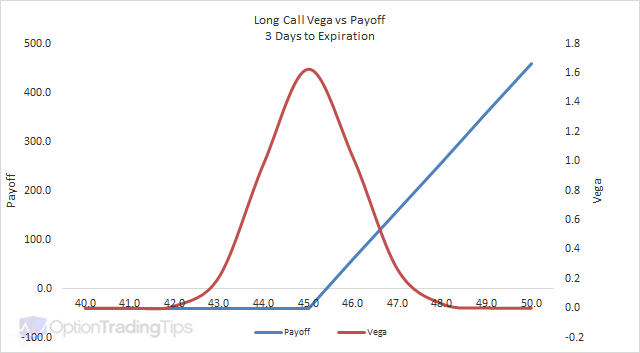
Vega
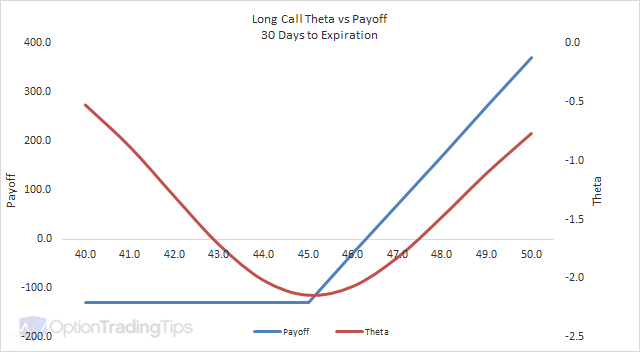
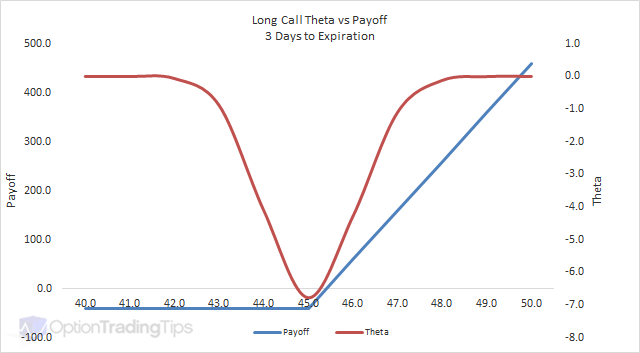
Theta
201 Comments
edna March 14th, 2012 at 4:09pm
Hi,
I'm in the money on call options which are coming toward expiration. The stock is still moving up and I'm not sure if I should get out "sell to close" or just let the contract expire. Could you please explain what happens with an in the money call option when you let it expire. Thanks!
Chris March 14th, 2012 at 3:12pm
Hi Peter,
I bought my first call option in January. I sold my Apple shares at $510 and purchased the equivalent May 15 $550 calls at $13. These are now worth $54 but I still have two months left and I don't want to take possession of the shares. How do I know when to sell? I assume if I wait to just a few days before May 15, I will lose some premium. My thinking is to let it run till about 3 weeks before expiry, then sell to close. What do you think?
Peter March 11th, 2012 at 7:24pm
Hi HK,
If you own the call option you don't have any exercise risk. The call buyer has the right to exercise the option so it is the seller of the call option that carries the risk of being "called" or assigned.
If you bought the call option for $0.10 then your risk is limited to the amount paid, which is $10 (0.10 x 100).
HK March 6th, 2012 at 12:55pm
OK, so this may sound stupid but I want to know the risk of owning a call option. Assuming I buy a call option at $.10, and 2 months later that call option is trading at $.25 and I want to sell my call option. Then, would I be obligated to sell the underlying stock if the purchaser of the $.25 decides to exercise?
Peter March 5th, 2012 at 5:56am
The market maker doesn't "have" to buy it back, but it's their business to make money providing two way markets. They have a theoretical edge in buying the option and hedging it with the stock.
If you don't have enough money in your account to cover an exercise your broker will probably borrow the stock for you and then sell it back immediately at the current market price.
Marc March 2nd, 2012 at 3:33am
Does the market maker have to buy the options back before or on the strike date?
Say I buy an $11 call option in the money for 3.60 on a march 17 option when its march 2nd. The stock is trading at $14.90 when I buy it. The stock now rallies and goes to 15.50. is my option now worth 4.50 and who' gonna pay me for it if I try to close it? Let's say I dont even have the money to buy the stock in my account. Do I risk a house call of $1100 per option or be forced to sell some shares out of my portfolio to cover and then forced to buy the stock at $11 a share on March 17 if no one buys my option? It's a good deal but what if I can't cover that amount? What if I have 10 contracts. Will I have to buy $11000 worth of shares if I cant find a buyer for the option to keep from just watching the options expire and losing my $3600.? (10 contract at 3.60 ea.) How does that part work.
All these training videos talk about what a call & put is but no one says who is gonna buy it if I try to close it. Can the market maker just ignore it and let it expire if stock volume doesn't merit using all the calls and puts he has sold on the strike date?
Peter March 1st, 2012 at 4:40pm
Hi Zach, yes, you're example is correct!
Peter March 1st, 2012 at 4:39pm
I appreciate the feedback D0SSlar$!
Zach March 1st, 2012 at 4:01pm
I know you probably answer this many times and reading things I seem to have an understanding but option trading seems really profitable and that usually means to good to be true for me. Lets say I want to buy 5 contracts of XYZ at 1.10 option price. I would pay a premium of $550. Now lets say that the option price increases to $2 the next day. I could then sell my options and make a profit of $450 over the premium? $2 x 5 contracts= $1000-$550 for premium correct?
D0SSlar$ March 1st, 2012 at 1:09am
Peter,
MY sincere thankyou for the excellent explanation for newbie in option trading. The most important learning i got from you that is the difference between "Closing" and "Excercising" the option, coming from a trading "real underlying stocks" , a new option trader need to understand that "Buy" a Call/Put option is a just a "Right/Obligation" between a seller and buyer, to make a "deal" a "fixed price" (Strike price) for the stock.
A "Seller" or "Buyer" depending on which side of the the deal he/she is standing can "let go" and "walkaway" i.e ("Closing") and walk away with a "Premium profit" or "Premium Loss" or "Excercise" (i.e "Take the delivery of the actual stocks -long)...what a great concept, the t of the Greeks andother stuff is basically a "barometer gauge the pulse of the underlying stock option price.
Bottomline once the trader buys the option contract, the "contract" behaves exactly like a "Stock or equity" from a technical perspective.
Thank you
Add a Comment