Short Put Option
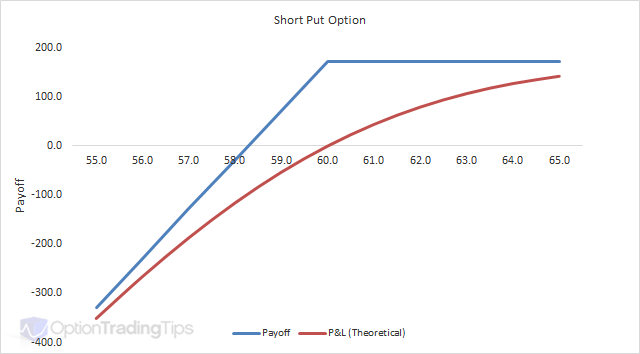
| B/S | Strike | Type | Price |
|---|---|---|---|
| Sell 1 | $60 | Put | $1.72 |
| Net Credit | ($172) | ||
A short put is the sale of a put option. It is also referred to as a naked put.
Shorting a put option means you sell the right to buy the stock. In other words you have the obligation to buy the stock at the strike price if the option is exercised by the put option buyer.
The Max Loss is unlimited in a falling market, although in practice is really limited to the total value of the exercised stock position — as a stock cannot trade below zero.
The Max Gain is limited to the premium received for selling the put option.
Characteristics
When to use: When you are bullish on market direction and bearish on market volatility.
Like the Short Call Option, selling naked puts can be a very risky strategy as your losses can be significant in a falling market.
Although selling puts carries the potential for large losses on the downside they are a great way to position yourself to buy stock when it becomes "cheap". Selling a put option is another way of saying "I would buy this stock for [strike] price if it were to trade there by [expiration] date."
A short put locks in the purchase price of a stock at the strike price. Plus you will keep any premium received as a result of the trade.
For example, say AAPL is trading at $98.25. You want to buy this stock but think it could come off a bit in the next couple of weeks. You say to yourself "if AAPL sells off to $90 in two weeks I will buy."
At the time of writing this the $90 November put option (Nov 21) is trading at $2.37. You sell the put option and receive $237 for the trade and have now locked in a purchase price of $90 if AAPL trades that low in the 10 or so days until expiration. Plus you get to keep the $237 no matter what.
The risk here is that the stock tanks before the expiration date leaving you with the potential to be exercised and take delivery of the stock at $90 when it, say, is trading at $80 when you are assigned the stock.
If the drop occurs early, and it is significant i.e. at or below the strike, you would want to re-evaluate your trade and potentially exit the option position before the losses increase. If the drop in stock value occurs close to the expiration date and is not yet through the strike price, a good exit plan is to put a short stop order on the stock itself. That way you'll be covered on the exercise if it happens while leaving the option position open to capture the remaining time value.
Option Strategy Swipe File
Ditch the text books. Instantly choose the right strategy for your needs with my one-page strategy template guide.
Short Put Greeks
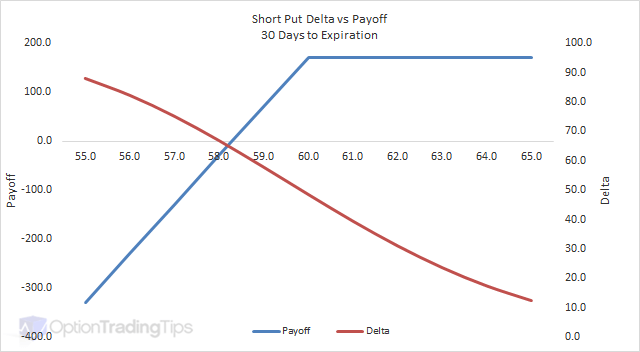
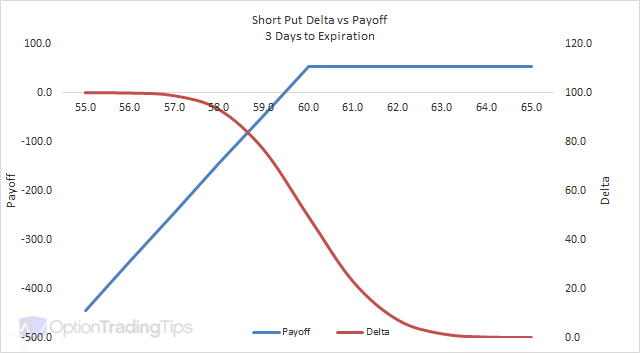
Delta
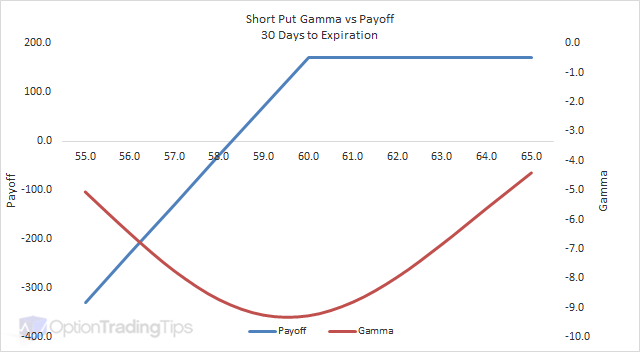
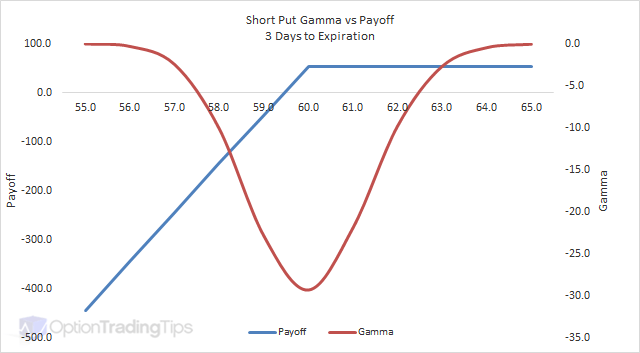
Gamma
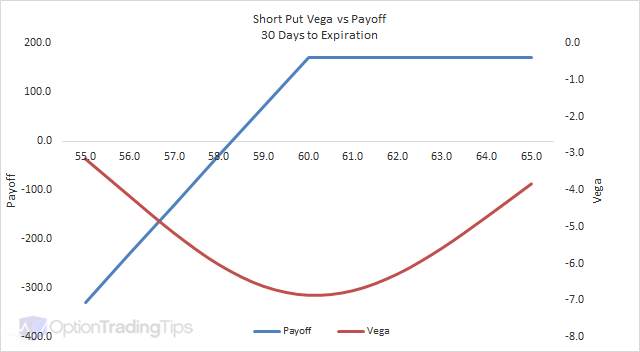
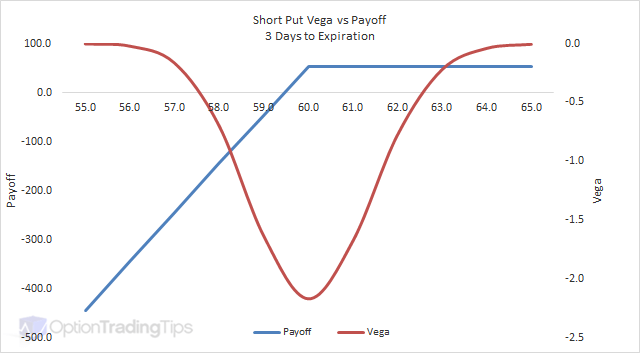
Vega
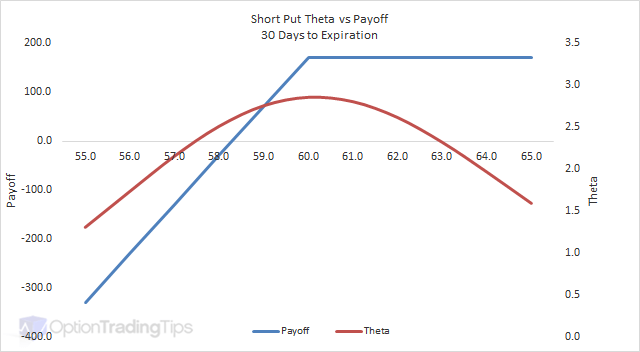
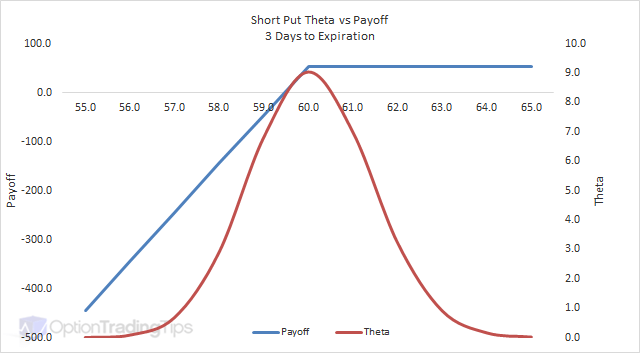
Theta
56 Comments
Peter March 23rd, 2015 at 6:26am
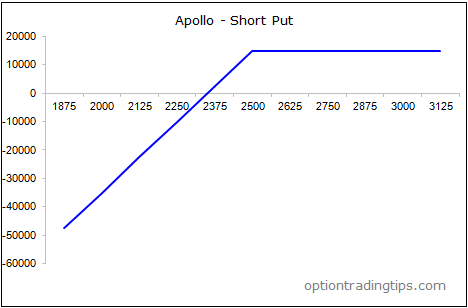
Like this?
Sk March 22nd, 2015 at 6:11am
Say you bought Apollo Options contract at Strike 2500 Premium 150
Draw a Short Put Pay off at below prices
2000,2100,2200,2300,2400,2500,2600,2700,2800,2900,3000
Peter February 22nd, 2015 at 10:46pm
No problem, happy to help! Let me know if there's anything else.
pk February 22nd, 2015 at 9:44pm
Peter,
Thank you. I think I understand now. So there is no actual interest fees the trader is paying for that margin being issued from the broker for selling non-cash secured puts. But there will be hold placed on a part of your account funds while the sold put is in play, thus not being free for other trades.
Not being charged a interest fee on the non-cash secured margin amount while selling puts seems like a pretty good deal to me.
I appreciate you being patient with some of us newer traders as we try to understand the game.
Thanks again
Peter February 22nd, 2015 at 9:15pm
Hi PK,
I see - I think there is some confusion in terms here. What you're referring to is a "margin" account, where the broker "lends" you some portion of money to trade securities.
However, for retails traders the margined (borrowed) value would typically only apply to stocks i.e. you couldn't trade options on the margin value - only cash can be used. I could be wrong, but seeing as options and futures are already leveraged instruments it would be too risk for brokers to allow these to be traded on borrowed money.
The margin I am referring to is the "initial margin" - or the amount of money allocated in order to support the position.
I.e. for a short option contract, you've not actually bought or sold the stock; only a promise to deliver if exercised. Therefore, the broker needs to allocate some of your account to reflect the risk involved in this position. This amount is also called a margin.
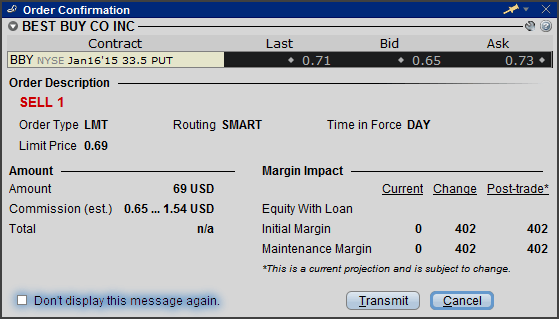
Take a look at the order confirmation pad of this short put option order I placed on BBY stock;
[Click to Enlarge]
I am selling a $33.50 put option, so expecting to go long the stock at a buy price of $33.50 for 100 shares if exercised. The total exposure would therefore be $3,350, however, the broker only allocates $402 of my account to support this position; 12% of the obligated size.
This margin won't "cost" you any interest; but will be deducted from the total amount of money in your account available for other positions.
Make sense? Let me know if not!
Pk February 20th, 2015 at 12:56am
Hi Peter,
I guess I might have misunderstood the concept of margin account totally?
I thought that margin account works this way:
say I have 50k in cash and based on that money they give a margin amount of 20k (I don't know the % numbers they use to come up with margin). so now I can use up to 50k freely as it is cash backed, but the extra 20k I can use but I pay interest on it to the broker. I was using roughly 6% interest rate I would have to pay them.
So going back to my example in the previous question, if I sold puts and stayed within that amount of 50k then I don't pay interest. But if I sold more number of puts and had to use 50k plus the 20k to cover my sold puts, I would be paying interest on the 20k to the broker? so there comes my question if selling a vertical put spread decreases the margin required from my account and thus me having to pay less interest but not maximizing my intake by not only selling puts but also buying puts in the vertical put spread VS. only selling naked puts and using up all my margin (50k + 20k) and paying some interest to the broker for the 20k?
if I did the selling of vertical put spread, I would buy an deep OTM put which is cheap just for the purposes of decreasing the margin needed.
I hope I explained it, I know it's kinda long. what i'm trying to get to know is if saving that interest payment on the margin I don't have to borrow anymore by doing the vertical put spread worth more vs. maximizing the full intake of selling naked puts without decreasing intake with the buying part of the vertical put spread?
Thank you very much!
Peter February 19th, 2015 at 10:32pm
Hi PK,
Yep, I hear you on the lower margin to free up capital - but not sure on the interest side of things.
I was under the impression that money allocated for margin doesn't impact interest earned on your balance? I.e. you will still earn interest on the money whether it is taken up in margin or just sitting there. Maybe I'm mistaken - may need to clarify with my broker.
Also, going for a put spread instead of naked put depends on your view of the stock. If you're punting on an upward movement and at the same time selling high vol options, then some downside protection is a good idea.
However, you might also be keen to go long the stock at the strike level - if it reaches that price by the expiration date - and at the same time collecting some premium in doing so.
pk February 19th, 2015 at 8:28pm
Hi Peter,
I tried posting several hours ago, but my question has not showed up yet so please excuse me if this ends up being a repeat post.
Is it better to sell vertical put spreads instead of selling naked puts? What I mean is say have stock ABC at 100, selling 95 strike puts x 10 for $1/per and buying 85 strike put x10 for roughly $0.25/per instead of just selling naked put 95 x10 for $1/per?
I am asking because this will reduce the margin needed. Which would decrease the amount of interest I would have to pay on the extra margin used, roughly 6%. Plus it would free up margin that I could use for another trade. Does the extra $0.25/contract I would not lose by doing a naked put vs a vertical put, more than worth worrying about paying margin interest.
I would like to hear your thoughts?
Thank you.
Pk February 19th, 2015 at 1:22pm
Peter,
Thanks for your response.
Quick question, what is your thoughts on a vertical put spread instead of just selling puts? If ABC is currently at $98, selling 95 10 puts ABC for $1 and buying 85 or 80 strike 10 puts for $0.25-$0.20; expiration date roughly 1 month out.
I know this reduces your net intake but doesn't it also reduce the margin needed? Thus freeing up margin for use in other trades and also reducing interest on the margin? Or do you think the money saved on interest on the margin is not usually equal to the amount needed to buy the put? Given margin interest around 4-5%?
Thanks,
Ok
Peter February 17th, 2015 at 4:02am
Hi Pk,
The problem is that as the stock crosses the strike level there is no guarantee that it will still be under the strike at expiration - and hence in need to be exercised.
What I meant to get across is that the short put option still has time value left in it i.e. a chance that it will expire out of the money and you keep the premium.
If you short the stock (by putting in a sell stop order) before the option expires, you could be left holding that position if the market rallies without taking delivery of the stock to offset it.
Sure, you can go and buy back the stock, but by that time you will surely be making a loss.
Unless I've misunderstood. I would also love to know a better way to play short puts ;-)
Add a Comment