Short Put Option
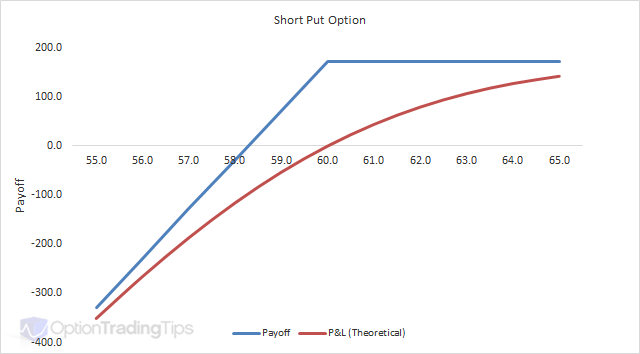
| B/S | Strike | Type | Price |
|---|---|---|---|
| Sell 1 | $60 | Put | $1.72 |
| Net Credit | ($172) | ||
A short put is the sale of a put option. It is also referred to as a naked put.
Shorting a put option means you sell the right to buy the stock. In other words you have the obligation to buy the stock at the strike price if the option is exercised by the put option buyer.
The Max Loss is unlimited in a falling market, although in practice is really limited to the total value of the exercised stock position — as a stock cannot trade below zero.
The Max Gain is limited to the premium received for selling the put option.
Characteristics
When to use: When you are bullish on market direction and bearish on market volatility.
Like the Short Call Option, selling naked puts can be a very risky strategy as your losses can be significant in a falling market.
Although selling puts carries the potential for large losses on the downside they are a great way to position yourself to buy stock when it becomes "cheap". Selling a put option is another way of saying "I would buy this stock for [strike] price if it were to trade there by [expiration] date."
A short put locks in the purchase price of a stock at the strike price. Plus you will keep any premium received as a result of the trade.
For example, say AAPL is trading at $98.25. You want to buy this stock but think it could come off a bit in the next couple of weeks. You say to yourself "if AAPL sells off to $90 in two weeks I will buy."
At the time of writing this the $90 November put option (Nov 21) is trading at $2.37. You sell the put option and receive $237 for the trade and have now locked in a purchase price of $90 if AAPL trades that low in the 10 or so days until expiration. Plus you get to keep the $237 no matter what.
The risk here is that the stock tanks before the expiration date leaving you with the potential to be exercised and take delivery of the stock at $90 when it, say, is trading at $80 when you are assigned the stock.
If the drop occurs early, and it is significant i.e. at or below the strike, you would want to re-evaluate your trade and potentially exit the option position before the losses increase. If the drop in stock value occurs close to the expiration date and is not yet through the strike price, a good exit plan is to put a short stop order on the stock itself. That way you'll be covered on the exercise if it happens while leaving the option position open to capture the remaining time value.
Option Strategy Swipe File
Ditch the text books. Instantly choose the right strategy for your needs with my one-page strategy template guide.
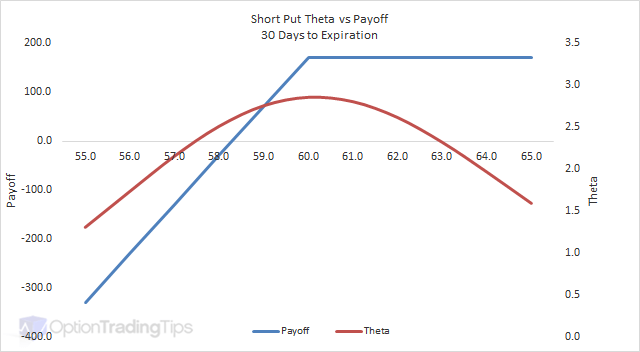
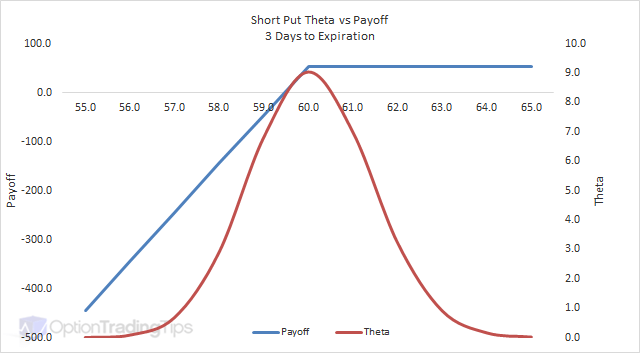
Short Put Greeks
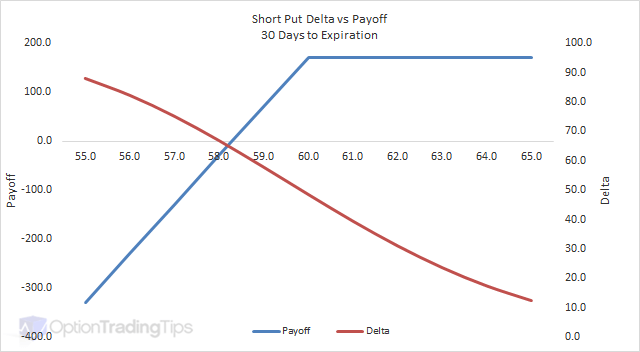
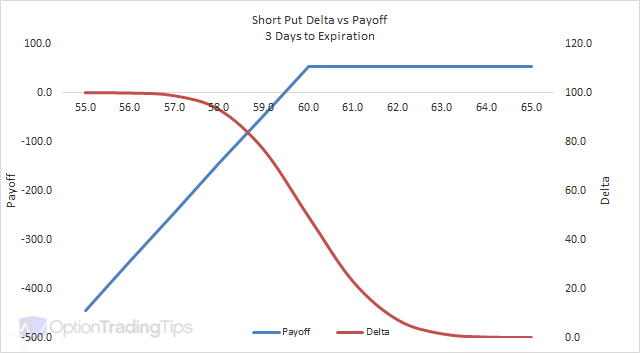
Delta
Gamma
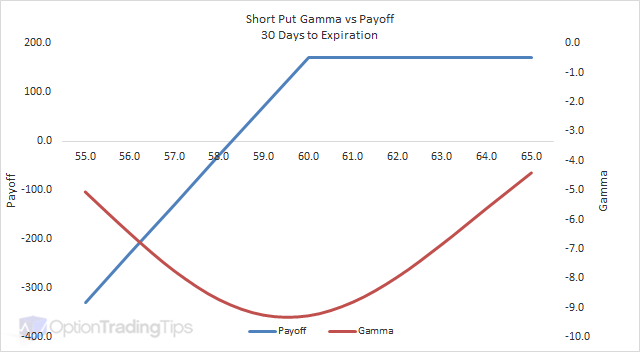
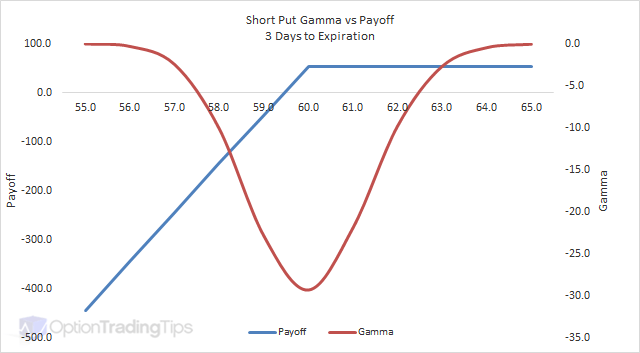
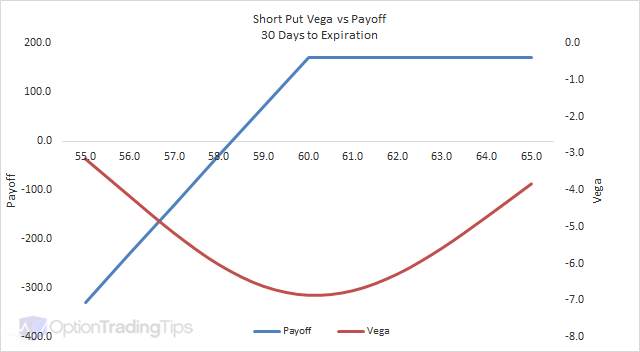
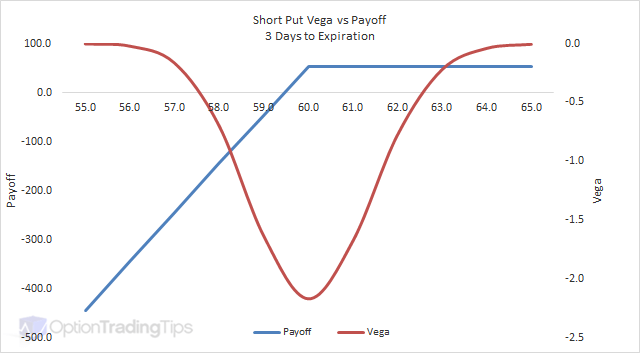
Vega
Theta
56 Comments
Mark November 16th, 2011 at 6:11pm
Sorry I guess I should have mentioned that I purchased 10 option contracts
Mark November 16th, 2011 at 6:06pm
Thanks for the quick reply Peter. I am using Etrade as the broker. I do see the margin of 4400 or so where there are accounting for what you are talking about.I am hoping that it doesnt have to get excerised and my concern is why the show of a loos. when I looked at the position in my main account it does show a market value loss of -$280 however in my trader platform it shows a loss of -$178. The strike price for the option I bought is 119 which expires in a few days. Assuming we never get that low by the end of the week, say maybe 121, which would still showing a loss. What happens to the loss? Do i still get the premium?
Peter November 16th, 2011 at 5:23pm
Hi Mark,
When you initially sold the put, $11 would have been credited to your account. But your position will be revalued according to the current market prices, so with the option now at 0.27 you would have a $16 loss on the position.
However, because you are short a naked option your broker will also deduct some money from your account as a margin in case you are exercised and have to take delivery of the underlying position. In this case, as it is an index, there won't be an exercise so the margin is used as a buffer against a large loss.
Is there a way that you can see the transaction breakdown to confirm? What broker do you use?
Mark November 16th, 2011 at 4:06pm
Hi Peter
I sold a naked put today... (sell to open a put OTM for SPY) It was the 119 nov put and i sold it for .11. I just wanted the premium for it. The market went down today and that same put is now .27. It is now showing a loss in my positions of about $180. Is this normal. I am assuming i can let this expire but what about the loss, dows it expire with the option?. Is it charged to me? because I dont see a premium recieved anywhere on my site.
Peter September 7th, 2011 at 7:48pm
Yes, you're right - the $5 put vs the $5 call implies a forward price for the stock of $3.13. I'm not sure why. I thought at first that it could be because of a dividend but the company has never paid a dividend and a $2.17 per share dividend seems a bit unrealistic.
I've asked a friend of mine who is a market maker for Australian stock options if he has any ideas and I'll reply when/if I find out.
Sam September 6th, 2011 at 1:42am
Thanks, Peter.
As I can see, the market is not that simple ir practice. If you take LDK solar, the put options are severly overpriced. Current stock price is $5,3, and December calls/ puts with strike price 5 are $0,7/$2,3 and the put is not even ITM...
The problem is that it is difficult to get the stock short, so you can't really hedge fully. Anyway, a week ago it was possible to form a position of -100 stocks, +2 calls and -1 put with guaranteed profits of ~ 18% in four months, the only problem is that you can't really go short easily :)
And i guess you can't be sure you will profit since the short might be recalled anytime.. Not a perfect market
Peter September 5th, 2011 at 5:34pm
Hi Sam, no you are right. This would present an arbitrage opportunity. Calls and puts must be priced according to the put call parity theorem.
This states that Call - Put = Stock - Strike.
Read more about put call parity here.
Sam September 1st, 2011 at 6:24am
Thank you, Peter. One more thing that is on my mind:
If ATM call and put options are traded at a huge difference, might there be an arbitrage opportunity?
Lets say:
the stock is at $10
$10 call trades at $1
while 10 put trades at $5
As I understand, they should trade close to each other.. What is my mistake?
In this example, if you short the stock, long 2 calls and short the put, you will fully hedge yourself and stay long with profits from an increase in price.
here is an improvised table based on the numbers. Am I missing something?
0 5 10 15 20 stock price
10 5 0 -5 -10 short the stock
-2 -2 0 10 20 long 2 calls
-5 0 5 5 5 short 1 put
3 3 5 10 15 RESULT
Based on these prises (if you are able to find this misspricing), you get a quaranteed hedged profit with it going up if the prices go up. I AM PUZZLED, so please tell me where is my mistake :) Thank you in advance :)
Peter September 1st, 2011 at 2:13am
Because you've sold the put your risk is that the market goes down and the buyer of the option exercises it.
If the put buyer exercises his/her option then you are obliged to buy the stock from him/her at the strike price.
So, in your case, if exercised you would have to take delivery of the stock at $10 and pay $1,000 per contract ( 10 x 100).
You would, however, keep the premium received when you initially sold the put option.
Sam September 1st, 2011 at 2:04am
Hi, I am a bit confused now:
let's say I short a put with a strike price of 10. Isn't the maximum loss I can take is -10 per share minus the premium (-1000 per contract)? In the same way as the put has a limited profit payout?
Are there any other points I need to look into? How do options react to splits, bankruptcy and so on?
I am pretty new in options trading, and sold a put with the plan to hold it until expiry, what are the risks involved?
Add a Comment