Short Put Option
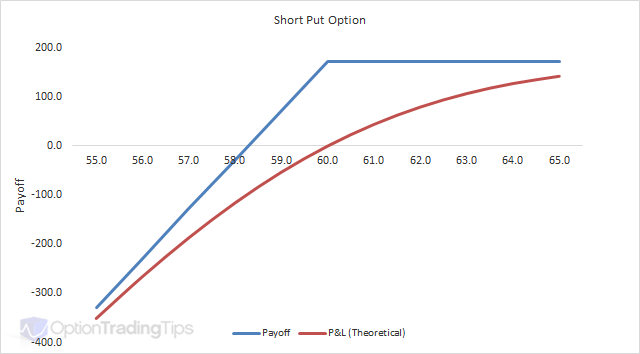
| B/S | Strike | Type | Price |
|---|---|---|---|
| Sell 1 | $60 | Put | $1.72 |
| Net Credit | ($172) | ||
A short put is the sale of a put option. It is also referred to as a naked put.
Shorting a put option means you sell the right to buy the stock. In other words you have the obligation to buy the stock at the strike price if the option is exercised by the put option buyer.
The Max Loss is unlimited in a falling market, although in practice is really limited to the total value of the exercised stock position — as a stock cannot trade below zero.
The Max Gain is limited to the premium received for selling the put option.
Characteristics
When to use: When you are bullish on market direction and bearish on market volatility.
Like the Short Call Option, selling naked puts can be a very risky strategy as your losses can be significant in a falling market.
Although selling puts carries the potential for large losses on the downside they are a great way to position yourself to buy stock when it becomes "cheap". Selling a put option is another way of saying "I would buy this stock for [strike] price if it were to trade there by [expiration] date."
A short put locks in the purchase price of a stock at the strike price. Plus you will keep any premium received as a result of the trade.
For example, say AAPL is trading at $98.25. You want to buy this stock but think it could come off a bit in the next couple of weeks. You say to yourself "if AAPL sells off to $90 in two weeks I will buy."
At the time of writing this the $90 November put option (Nov 21) is trading at $2.37. You sell the put option and receive $237 for the trade and have now locked in a purchase price of $90 if AAPL trades that low in the 10 or so days until expiration. Plus you get to keep the $237 no matter what.
The risk here is that the stock tanks before the expiration date leaving you with the potential to be exercised and take delivery of the stock at $90 when it, say, is trading at $80 when you are assigned the stock.
If the drop occurs early, and it is significant i.e. at or below the strike, you would want to re-evaluate your trade and potentially exit the option position before the losses increase. If the drop in stock value occurs close to the expiration date and is not yet through the strike price, a good exit plan is to put a short stop order on the stock itself. That way you'll be covered on the exercise if it happens while leaving the option position open to capture the remaining time value.
Option Strategy Swipe File
Ditch the text books. Instantly choose the right strategy for your needs with my one-page strategy template guide.
Short Put Greeks
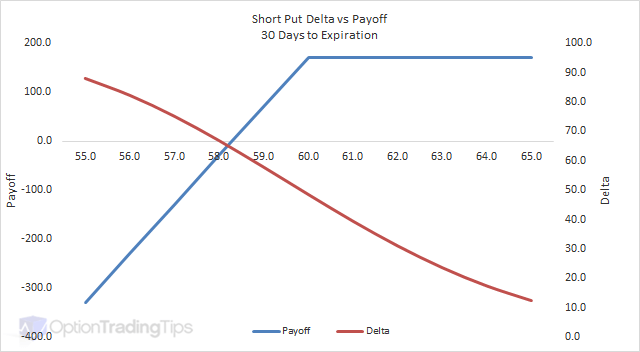
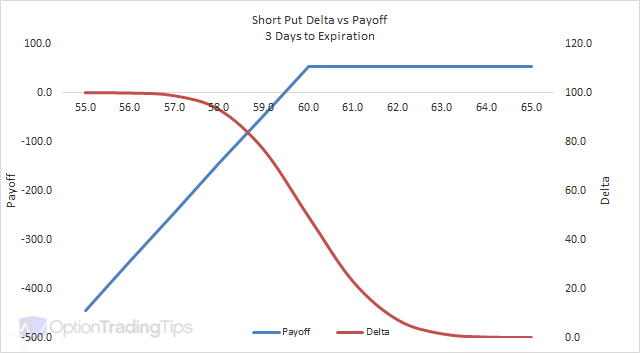
Delta
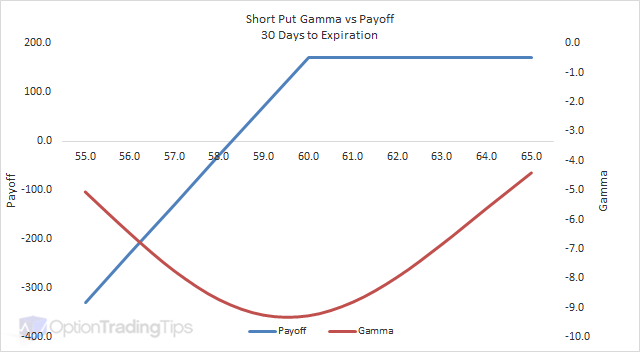
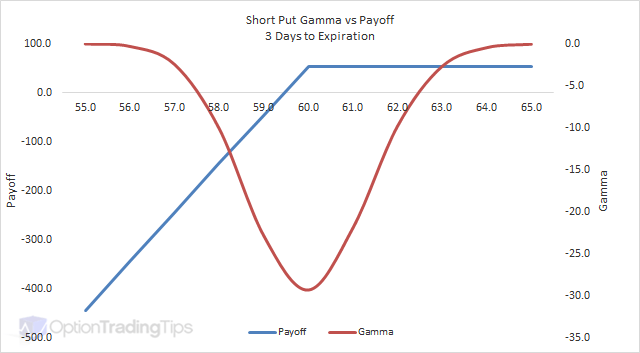
Gamma
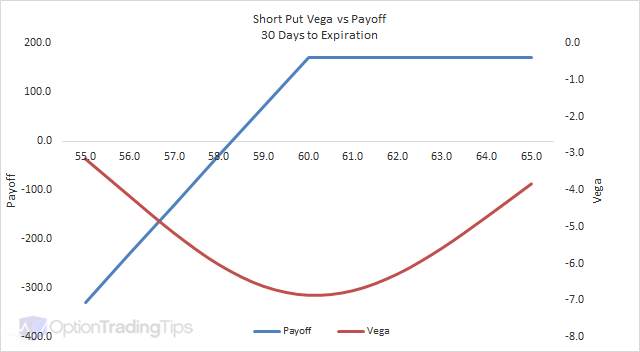
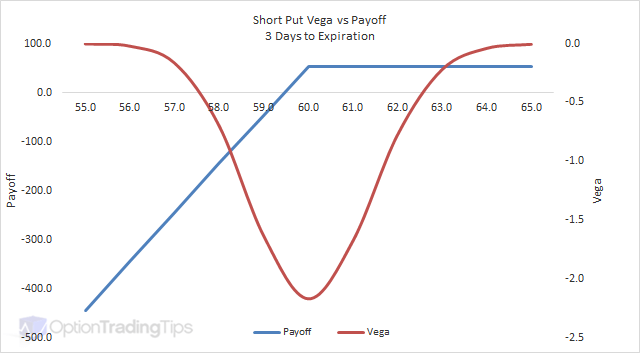
Vega
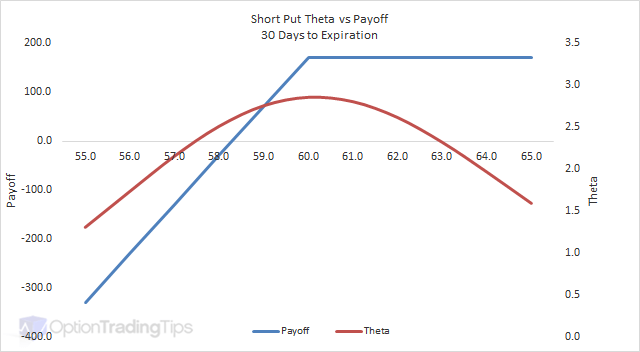
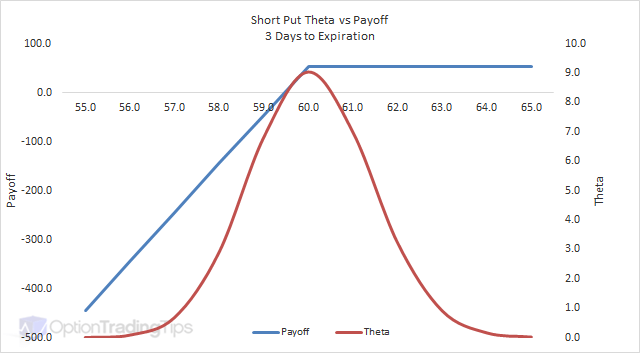
Theta
56 Comments
Peter October 25th, 2010 at 7:20pm
Some solid tips there Joel...thanks!
When you say 50/200 trend zone...are these simple moving averages?
Joel October 25th, 2010 at 5:41pm
I agree that selling the put is a good way to buy the stock for a bit less than the current selling price - in other words, to take advantage of a dip during the option period. I'm using this to buy strong dividend paying stocks at a discount if they are above the 50/200 day trend line, and I want to own that stock anyway - as Mjasko noted about Goodyear.
So the strategy for dealing with otherwise idle and unneeded cash that is sitting besides an otherwise fully diversified portfolio:
1 - find a reliable stock you want to own that also pays a good dividend - Motley Fool Income report has many suggestions, as do other sources/articles.
2 - understand the stock's valuation, making sure it has room to rise
3 - look at the 'technical' chart (e.g., on Yahoo) and see the zone between the 50-day and 200-day trend lines. If you're basically bullish on the stock, you'll want to buy between them, expecting a bounce at or above the 200 day line.
4 - Look at the next dividend date
5 - If the current price is within the 50/200 day zone, buy the stock and sell a covered call (Buy-Write); you've already got the price you want, and you can start collecting dividends and option premiums. If then option is called and you 'lose' the stock - although you've 'missed' additional upside, you've still made money - repeat all steps, including step 6 below.
6 - If the current price is above the 50/200 day zone, look for a strike price within that zone, and pick an option exercise date that has reasonable volume (you can see all of that on Yahoo Quote on the symbol, and then Options). Sell the put, pocket the cash, and see if the price drops into the 50/200 day zone and you get the stock. If it doesn't, then do all the stpe over again - you're only missing the upside of something you don't own.
If somehow this is your primary investment strategy, you are probably better off doing it through a buy/write ETF or closed end mutual fund and not on your own....
Mike Griffin September 23rd, 2010 at 5:08pm
Here's how a short-put works: you sell the put (thus getting the put-price x 100). You either keep the put until expiration, or you buy the same put (at whatever the current put-price is) to "close" your position. If you close then your profit (or loss) is the difference between the sold put-price and the current put-price (put-price is another way of saying "premium").
If it looks like the stock-price will remain above the strike-price then you should probably hold the short position until expiration, because the put will probably expire worthless and you will be able to keep the "premium" you got for selling the put in the first place.
If it looks like the stock-price will drop below the strike price at any time before expiration, (because of expected bad news, bad earnings report, etc.) then you should close your short position as soon as possible. Got it?
PS-being long a put is the opposite of being short, (i.e. you buy the put instead of selling it).
Peter August 11th, 2010 at 6:04pm
It is only worthless if the underlying is trading above the strike price at the expiration date.
If the underlying is trading below the strike price at the expiration of the option then the option is worth the strike price minus the underlying price, which is your loss if you are short the option.
Emmanuel Armah August 11th, 2010 at 10:29am
I don't understand why we use unlimited loss,
because you know your losses right from day one that the maximum loss is when the option expires the option becomes worthless.
am i right ?
Mjasko April 16th, 2009 at 12:52pm
All of these comments deal with short term loses or gains. For me the question is whether the stock or company in question is a good buy at some price. If you believe that Goodyear is a good buy in any case at 15 and the stock is 20 who is really worried if Goodyear goes to 5 in the short term. All my equities have loss value lost value in the past year. Do I like it? No. But I am not in the market short term. Do I expect the market to go to zero. If it does then I have a lot more to worry about than the lost of a few dollars. Goodyear at zero is absurd...so why all the talk of unlimited loss...If you are so worried about loss stay out of the market. If you are long-term bullish then selling puts makes sense
Admin February 15th, 2009 at 2:23am
You aren't anticipating the stock to drop...you are anticipating it to rally. If the stock is above the strike at expiration you keep the premium.
SGL# February 15th, 2009 at 1:33am
How is a short put considered bullish if you are anticipating the stock to drop?
Admin December 18th, 2008 at 6:22pm
Yep, noted. I mentioned it below too:
"I guess it is not really unlimited as a stock price cannot go below 0."
Rick December 18th, 2008 at 1:13pm
"Maximum Loss: Unlimited in a falling market.", not really , how far can AAPL fall , cant go beyond 0 (zero)
Add a Comment